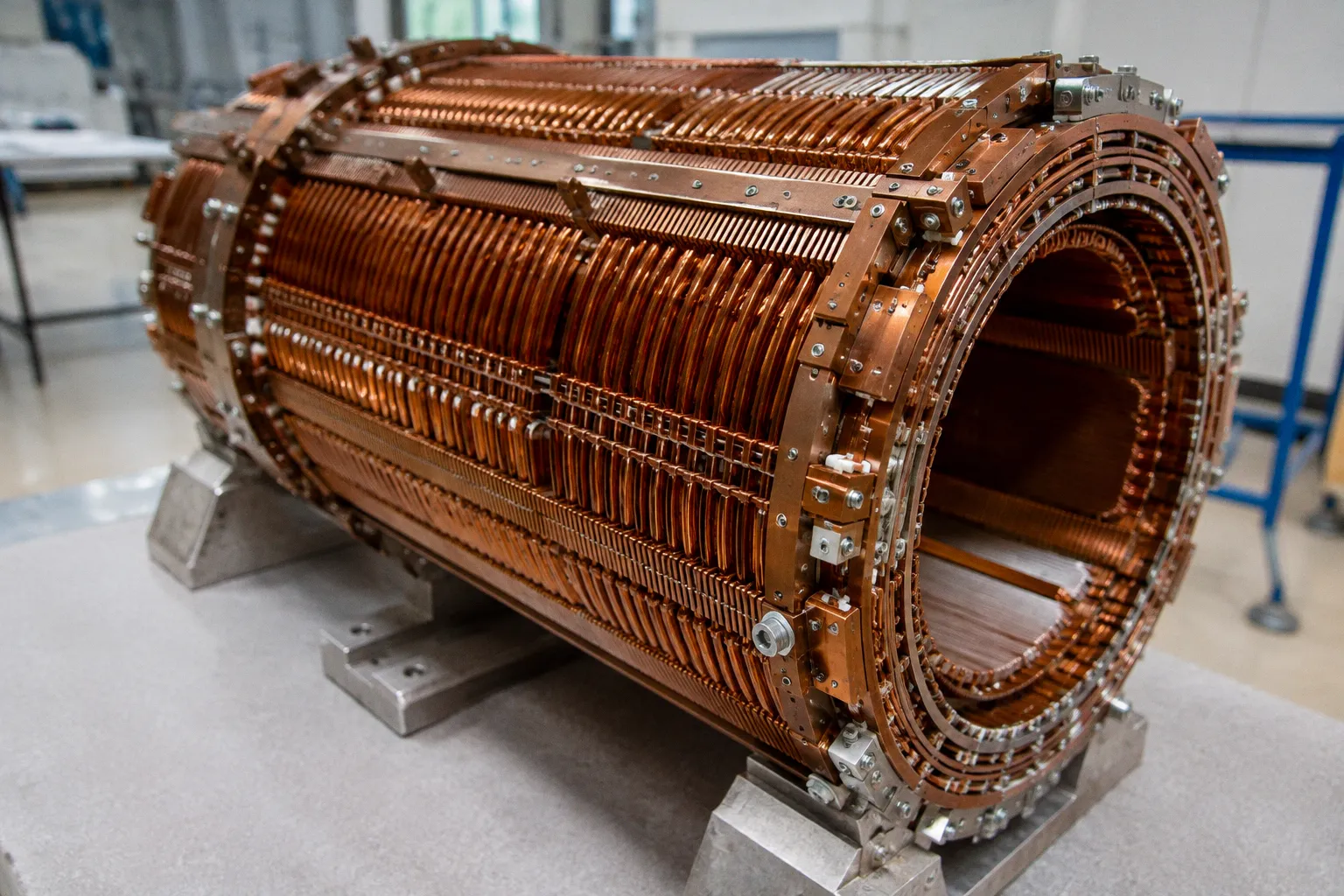
A Conventional MRI Magnet Is a Helium Logistics Operation With a Coil Wrapped Around It
That bath is the only environment in which the niobium-titanium windings will carry current without resistance and let a clinical-grade magnetic field persist indefinitely. Lose the bath and you don't have a magnet. You have a very heavy, very cold doorstop that needs to be warmed, inspected, re-cooled, and re-shimmed over a service window that will make your operations director weep. So hospitals don't just buy a magnet. They buy a helium logistics contract, a quench pipe routed through three floors of building envelope, and a quiet, ongoing dependency on a global commodity that has, at various points over the last decade, looked genuinely scarce.
Now contrast that with a sealed-helium design: about seven liters — half a percent of the conventional inventory — locked inside the cryostat at manufacture, no top-up port, no refill truck, no quench pipe through the roof. That pitch is not pure brochure optimism. The architecture is genuinely different. But "genuinely different" is not "proven at ten-year field-stability parity with a wet magnet," and the literature has not yet closed that gap.
The cheapest helium is the helium you never have to refill. The most expensive magnet is the one whose long-term drift data nobody has yet.
The Physics of Sealed-Helium Magnet Architecture
In a conventional "wet" magnet, the superconducting windings are immersed directly in a bath of liquid helium. The bath is the thermal reservoir: it absorbs whatever heat leaks in and boils off slowly. As long as you keep topping it up, the magnet stays cold. A quench — a sudden loss of superconductivity — releases the magnet's stored energy as heat, boils off a large fraction of the helium in seconds, and forces a controlled emergency venting through a quench pipe routed up and out of the building. Liquid helium expands roughly 750 times its liquid volume at room temperature and pressure, which is why the quench pipe exists and why your architect needs to know about it during siting.
A sealed-helium design replaces the bath with a closed micro-cooling circuit. About seven liters of helium — or thereabouts — is sealed inside the cryostat during manufacture and never touched again. A mechanical cryocooler (a cold head, typically a two-stage Gifford-McMahon or pulse-tube unit) pulls heat out through a thermal bus, conducting it away from the windings. The windings themselves never sit in a bath. They sit in vacuum, with thermal straps to the cold head.
That changes the operational math in three places at once: helium logistics disappear, the quench pipe disappears, and the magnet's tolerance for thermal transients drops. The first two are the headline. The third is the part the brochures gloss over.
You didn't eliminate helium. You eliminated the refill schedule and moved the dependency into the cryocooler's service contract.
Conduction Cooling: How It Works, What It Costs
A liquid helium bath has serious thermal mass. It buffers short interruptions — a brief power blip, a compressor hiccup — without the magnet warming appreciably. A conduction-cooled architecture has no equivalent buffer. If the cold head fails, or if the helium compressor feeding it loses grid power, the windings start warming immediately. The seven liters of helium are still there, but they are not in direct contact with the coils; they are a working fluid in a closed loop that depends on a mechanical pump and a steady electrical supply.
The heat loads the cold head has to remove are small but non-zero:
- Radiation heat leak through the vacuum jacket
- Conduction through the current leads feeding the windings
- Eddy-current heating during ramp-up, ramp-down, and shimming
- Mechanical vibration transmitted from the building structure through the mount
For a hospital in a region with stable grid power and an uninterruptible supply on the imaging suite, this is mostly fine. For a hospital in a region where brownouts are an afternoon hobby, the operational question becomes: how does a sealed magnet behave during a 30-second power interruption at 4.2 Kelvin? Vendor literature is reassuring. Independent, head-to-head failure data comparing cold-head reliability between dry and wet systems under grid instability is, as far as the current peer-reviewed record goes, sparse. That is one of the more honest gaps in the published evidence base, and it is worth naming out loud before signing the capital purchase order.
Cold heads are also mechanical devices with moving parts — typically a displacer or a regenerator running at a few hertz. They wear. In a wet magnet, a cold-head failure is inconvenient but not catastrophic: the helium bath holds temperature long enough for service. In a sealed system, a cold-head failure during off-hours is a magnet-warming event. Vendors offer redundancy options (dual cold heads, automatic switchover), but those are options, not standards, and they change the cost conversation.
Operational Implications of Killing the Quench Pipe
The headline infrastructure saving from going sealed-helium is the quench pipe. A conventional 3T magnet's quench pipe has to route from the scan room, often up multiple floors, to an exterior vent. It has to handle the 750x expansion of the helium inventory during a quench, which means pipe diameter and exit geometry are not negotiable. It has to be coordinated with HVAC, structural, and fire-suppression engineering. For a retrofit into an existing building, the quench pipe alone can be the difference between a feasible install and a non-starter.
A sealed magnet produces, during a worst-case quench, the equivalent pressure rise of seven liters expanding by 750x — on the order of a few cubic meters of gas. That can be handled with internal pressure relief inside the magnet housing. No pipe through the building. No exterior vent. No architectural coordination meeting that lasts eleven weeks. For a hospital trying to add a 3T into a converted office suite, this is the part of the pitch that genuinely changes what gets built.
What replaces the quench pipe in the operational budget is the cryocooler service schedule. In a wet magnet, helium top-ups and cold-head service are routine and decoupled — you can refill helium without touching the cold head, and vice versa. In a sealed system, the cold head is the consumable. Manufacturers specify service intervals measured in years, but those intervals assume steady operating conditions. Sites that run their magnet heavy — high throughput, long days, frequent ramp and deramp cycles — will be the test cases for whether those intervals hold under real clinical workload. Independent long-term operational data is, again, not yet thick on the ground.
Removing the quench pipe is a construction win. Owning the cold-head service interval is a new line item.
Clinical Equivalence and Long-Term Stability
This is where the vendor narrative gets tested against the published evidence, and where the procurement team should be reading carefully rather than listening to the demo.
The headline claim from manufacturers of sealed-helium systems — Philips introduced its BlueSeal architecture on 1.5T platforms in 2019 and extended it to 3.0T platforms in late 2024 and into 2025 — is that field homogeneity and temporal stability are compatible with clinical imaging across the relevant protocol set: routine neuro, MSK, body, contrast-enhanced studies, the usual 1.5T and 3T workload. Peer-reviewed narrative reviews largely echo that the underlying physics supports it, and early clinical adopters report protocol equivalence within their own single-center cohorts.
What those same reviews note, and what is worth underlining before any capital decision, is that robust multi-center clinical equivalence across complex sequences (diffusion, spectroscopy, advanced fMRI) and standardized independent benchmarks for unplanned service events, energy consumption, and longitudinal field drift remain limited. Most of the published data is vendor-led, single-site, or both. The first generation of sealed-helium magnets has only been in clinical service for roughly six to seven years. The ten-year field-stability comparison that would put a sealed magnet on equal evidentiary footing with a wet magnet does not exist yet, because the oldest sealed units simply have not been running that long.
That is not a deal-breaker. It is a maturity gap. But it is a maturity gap that should be priced into service-contract expectations and replacement-cycle planning. A magnet purchased this year will need to perform through the early 2030s. The performance data we have for sealed-helium magnets stops well short of that horizon.
| Reliability Parameter | Conventional Wet Magnet | Sealed-Helium Magnet |
|---|---|---|
| Liquid helium inventory | ~1,500 L, periodic refill required | ~7 L (≈0.5%), sealed at manufacture |
| Cooling mechanism | Liquid bath at 4.2 K | Conduction cooling via cryocooler |
| Quench venting | External quench pipe required | Internal pressure relief, no external pipe |
| Thermal buffering during power interruption | High — helium bath absorbs short transients | Low — no bath; cold-head dependent |
| Cryocooler service role | Auxiliary, decoupled from helium top-up | Primary consumable; interval governs uptime |
| Multi-center clinical equivalence data | Extensive across decades of service | Limited; mostly single-site and vendor-led to date |
| Longitudinal field drift data (10+ years) | Available | Not yet available — oldest units under 10 years in service |
Weight, Siting, and the Retrofit Math
The other headline number — and the one facilities teams fixate on first — is weight. Sealed-helium magnet designs come in up to roughly 2,050 kg lighter than conventional units of equivalent field strength. That is not a cosmetic figure. It is the difference between a magnet that needs a reinforced structural slab and one that can sit on a standard hospital floor. For a 1.5T going into a community hospital that previously could not take the loading, this is the single biggest enabler. For a 3T going into a retrofit suite in an older building, it can be the difference between feasible and infeasible without major structural work.
What it does not mean is "easier install." The magnet is lighter, but the bore is the same, the fringe-field management is similar (active shielding has largely taken care of siting footprint for both architectures), the RF coil suite is unchanged, and the cooling-water and electrical service are comparable. You save on structural engineering. You do not necessarily save on the rest of the project. Anyone who has watched a 1.5T install knows the magnet drop is one day in a six-week build.
The other thing weight reduction enables is mobile and relocatable configurations that were marginal with conventional magnets. Lower mass means lower transport load, which means more sites are logistically reachable. That has implications for shared-resource models, mobile stroke imaging, and rural deployment — none of which are guaranteed wins, but all of which become more discussable when the magnet is no longer the heaviest object in the building.
Verdict
The sealed-helium architecture is real engineering, not a slide-deck concept. The seven-liter inventory, the elimination of the quench pipe, the 2,000+ kg weight saving — these are physical facts about how the system is built, and they translate into real operational differences: no helium logistics contract, no refill scheduling, simpler siting, lighter floor loading. For new builds and many retrofits, the value proposition is genuine.
What is not yet established is whether those gains hold at ten- and fifteen-year service horizons in real clinical environments. The peer-reviewed record currently rests on early-adopter, single-center, and vendor-led data. Independent multi-center benchmarks for field drift, cold-head reliability under variable grid conditions, and clinical equivalence across advanced pulse sequences are still being accumulated. For a hospital buying a magnet this year with an expected operational life through the early 2030s, that is the gap to price into the service contract rather than wave away in the demo.
The technology is worth taking seriously. The procurement conversation is worth having slowly.