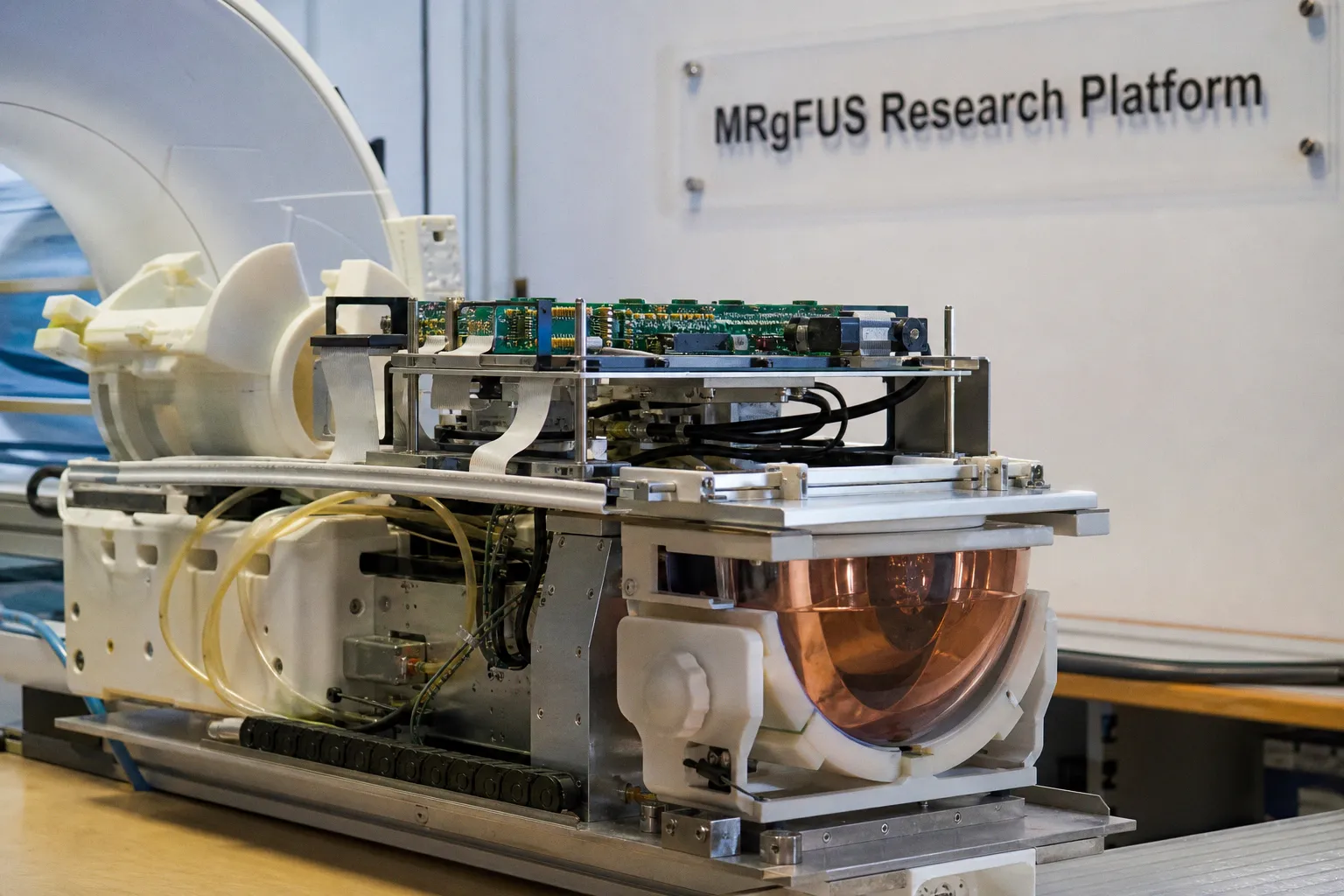
An 11.5% long-term CAGR projection for Magnetic Resonance Imaging Guided & Focused Ultrasound Devices, distributed via EIN News on August 14, lands inside the bore as an acquisition constraint. The number is not the story; the hardware it finances is.
MRgFUS is a hybrid room by construction. A therapeutic phased-array transducer enters the imaging envelope, focused acoustic energy converges on a target, and the scanner must keep returning diagnostic-quality images while sonication heats tissue. That dual duty taxes gradient fidelity, RF chain linearity, and phase stability in ways a standalone diagnostic run does not. A rising installed base means more sites will demand thermometry sequences, acoustic-correction reconstruction, and motion tracking that survives microbubble-induced susceptibility shifts. The published headline figure — 11.5%, with no methodology disclosed in the aggregator summary — is a procurement input. For an acquisition physicist, it converts into a request for SNR budgets that hold under the transducer, not at the bore entrance.
Reconstruction pipelines inherit the load
Every added MRgFUS suite pushes more raw data through thermometry and PRF-based phase-difference reconstruction. Those pipelines tolerate small displacements; they degrade when sonication duty cycles exceed their temporal model. A growing fleet means more vendor sites shipping presets that have not been validated on third-party gradient hardware. The algorithmic reviewer reads the CAGR as an incoming stream of support tickets, not as an opportunity. The maths does not get easier as the fleet gets larger.
Adjacent reports cluster the same vendors
Two related market notes appeared in the same eight-day window. OpenPR published a brief on The Global Intracranial Pressure Monitoring Devices Market on August 14. The National Law Review distributed Image Guided Surgery Devices coverage at 13% CAGR on August 11. Three image-guided intervention categories — focused ultrasound, intracranial pressure sensing, image-guided surgery — surfaced inside one news cycle. For a software developer tasked with multimodal registration, the clustering is more informative than any single CAGR: vendors are positioning across the stack, and the integration surface for MRI pipelines will keep widening.
Audit before you procure
Pull the underlying report, not the press release. Demand the base year, the currency model, and the unit definition — installed rooms, transducers, or both. For any sequence running inside the suite, require thermometry accuracy verified at your specific gradient slew rate and echo-train length, not at generic vendor defaults. SNR loss inside the MRgFUS coil must be measured against a reference head coil under matched loading. Reconstruction pipelines handling acoustic phase drift should be tested on the vendor's worst-case sonication duty cycle, not on idle scans.
CAGR justifies a budget line. Physics still justifies the install.