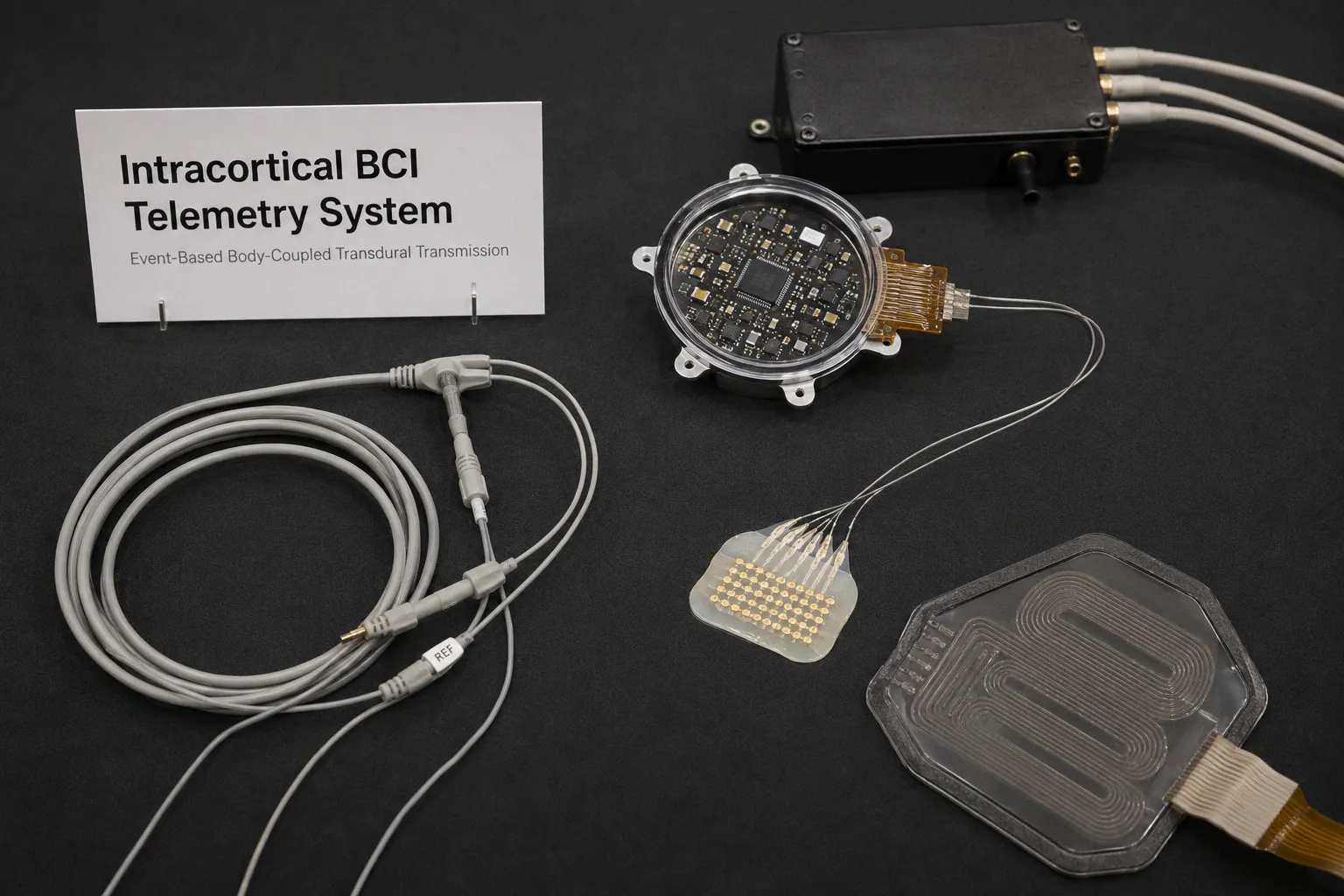
For clinicians who have watched patients with locked-in syndrome wait years for a viable communication bridge, the steady drip of brain-computer interface papers carries a particular emotional weight. According to a recent Nature publication, one such paper has now outlined an event-based, body-coupled transdural telemetry approach aimed at intracortical interfaces — a methodological contribution that, even at the title stage, invites a slow and careful read.
What the framework proposes
The work, as its title suggests, centers on how neural events recorded beneath the dura might be telemetered using the body itself as a conductive channel, rather than relying on percutaneous cabling or conventional implanted radio links. Consider the implications for longitudinal monitoring: even modest reductions in the hardware footprint of chronic intracortical recording could reshape the trajectory of how we follow subtle cognitive and motor degradation in conditions ranging from amyotrophic lateral sclerosis to the slow neurological aftermath of stroke. Event-based encoding, the framing implies, may also help manage power budgets and thermal load on cortical tissue — two constraints that quietly govern every chronic implant decision.
A wider field in motion
This publication does not arrive in isolation. In the same window, industry coverage has pointed to non-invasive brain-computer interfaces charting a path toward commercialization, while separate reporting notes a new partnership between Butterfly Network and Merge Labs around ultrasound-based brain-computer interfaces. A further technical write-up describes a transformer-based architecture for BCI training across language, imagery, limb movement, and emotional signaling. Read together, these threads sketch a field that is simultaneously diversifying its hardware approaches — electrical, ultrasonic, body-coupled — and consolidating around shared computational backbones.
What deserves our patience
The honest clinical question, as ever, is not whether a new telemetry scheme can move bits across tissue, but whether it preserves the fidelity of the signal we need to interpret. Whether body-coupled transdural telemetry earns a place in translational pipelines will depend on biostability, long-term signal drift, and the unglamorous engineering of hermetic encapsulation — concerns that tend to surface only after the first generation of devices has spent enough time inside a human skull. For now, the publication is best read as a methodological signal worth tracking, not a clinical endpoint to celebrate.