The central claim is clinically important: a single decoding model may be able to transfer across people, reducing the need to rebuild a system from the beginning for every patient. For neuroimaging and neural-interface developers, however, the practical question is not simply whether cross-subject decoding works, but how reliably signals from different brains can be aligned without erasing the biology that makes each brain distinct.
The calibration problem is biological, not merely technical
BCI systems have traditionally faced a difficult translational bottleneck. Neural signals vary between individuals because recordings may come from different implantation locations, reflect different patterns of functional activity, and be shaped by different learning histories. A decoder trained for one person therefore cannot automatically be expected to interpret another person’s brain activity.
The speech study, described as Cross-subject decoding of human neural data for speech brain-computer interfaces, examines whether invasive recordings from multiple participants can be used to train a shared neural-to-phoneme decoder. The intended clinical pathway is communication for people who have lost the ability to speak because of conditions including ALS, stroke, or brain injury.
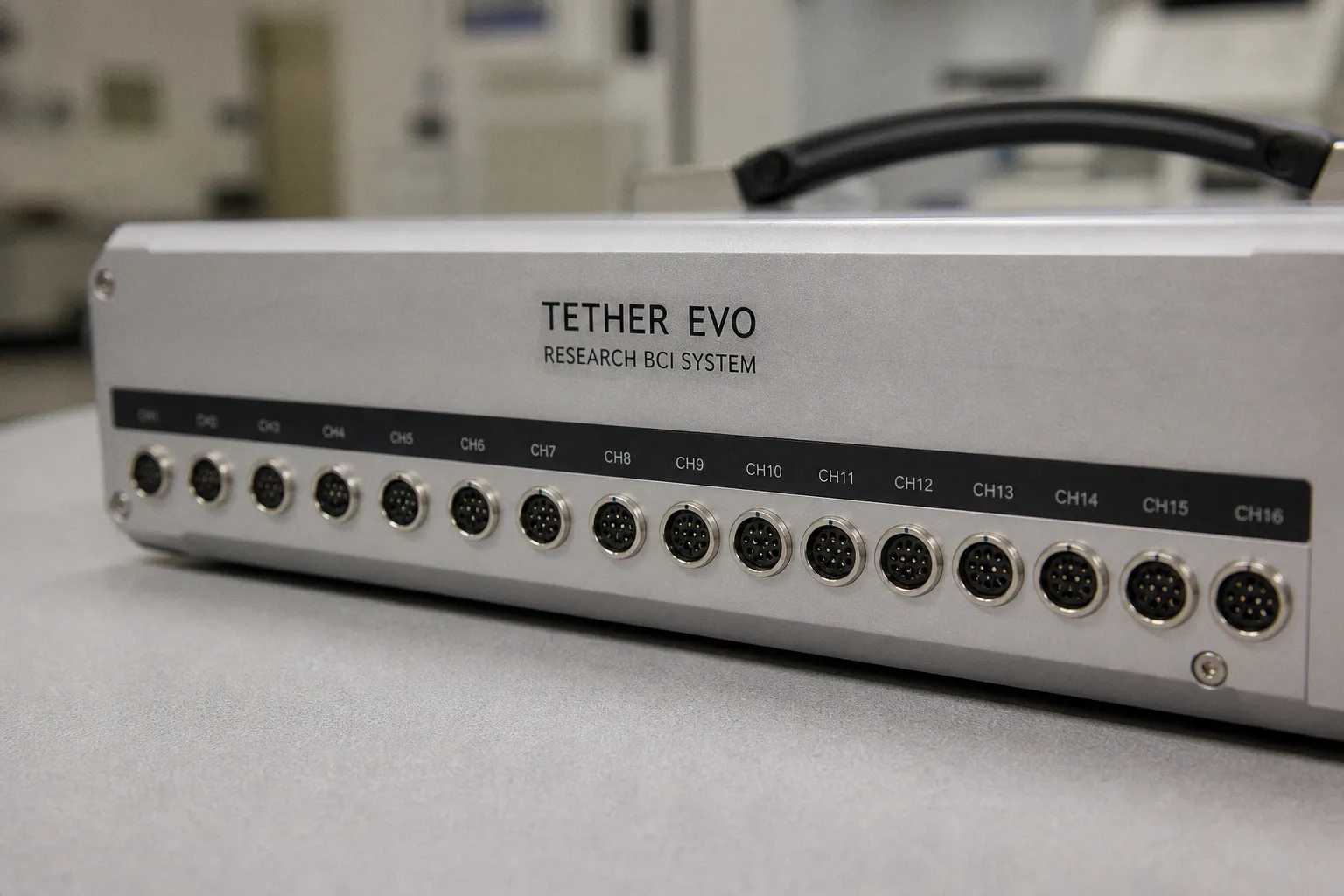
According to the article, Tether Evo and collaborators at the University of Rome Tor Vergata used a lightweight mathematical realignment step to bring signals from different brains into a shared space. A layered decoding network then uses the common structure of speech-related activity while allowing the model to be adjusted for a new individual. The reported result matched or exceeded contemporary single-patient systems, while adapting to a new person in minutes to hours rather than requiring a much longer calibration process.
That distinction matters. In a clinical setting, reducing calibration is not just a matter of convenience: it could affect how quickly a system can be evaluated, tuned, and incorporated into a patient’s daily communication. At the same time, the available evidence here comes through a sponsored article, and the report does not provide the full performance tables, cohort details, or validation conditions needed to assess how robust the finding is across clinical populations.
Shared models, different neural representations
The research also extends beyond speech. In work involving vision, researchers from Tether Evo and UniTOV recorded brain signals from macaques viewing thousands of images and reconstructed what the animals were seeing from that activity.
The report says that, using 200 milliseconds of neural data, the model selected the exact image from thousands with 70% accuracy and generated a plausible reconstruction reflecting its shape, colour, and content. This is a striking demonstration of temporal efficiency, but it should be interpreted as a result in an animal experiment rather than evidence of a ready clinical visual prosthesis.
The broader methodological shift is from treating every participant as an entirely separate decoding problem toward identifying features that can be shared, then realigning the remaining subject-specific variation. In software terms, this may reduce the amount of patient-specific training required. In biological terms, it raises a more subtle question: which neural representations are stable enough to transfer, and which are inseparable from the individual recording site or the person’s own cognitive and motor history?
Consider the implications for MRI and multimodal neuroimaging. A shared BCI model may eventually depend not only on signal processing, but also on accurate characterization of cortical anatomy, implantation location, and functional organization. If those variables are not tracked longitudinally, an apparent failure of generalization could reflect poor alignment rather than an absence of transferable neural structure.
What developers and clinical teams should watch
The immediate significance of Tether Evo’s work is therefore not that it resolves patient-specific variability, but that it proposes a route around one of the field’s most persistent costs: starting again with every new brain. The next evidence to examine will be independent replication, the number and diversity of participants, performance after transfer, and whether the claimed calibration window remains stable when recordings change over time.
The distinction between a promising cross-subject model and a clinically dependable system will be made in those details. A decoder that performs well under a controlled experimental protocol may still encounter gradual signal drift, differences in electrode placement, or subtle degradation in recording quality during longitudinal use. This shift allows the field to ask a more useful question than whether one model can read every brain: how much of the model can be shared, and how much must remain faithful to the individual neural trajectory?