For translational pipelines, this is the missing bridge: rodent circuit assays and primate imaging no longer need to occupy separate coordinate spaces.
What a Cross-Species Reference Actually Demands
Mouse and marmoset parcellations diverge at every level — cortical layer definition, atlas granularity, acquisition contrast. Any map claiming to link them must commit to a coordinate frame and tolerate the resolution gap between micron-scale rodent histology and millimeter-scale primate MRI. For segmentation pipelines, the operational test is whether the new alignment can be ingested as a transform layer or whether it forces retraining of existing label models. Until that is verified, the map remains an anatomical claim, not a software artifact.
The Consistency Floor Is Still Low
A separate analysis covered by Medical Xpress sharpens the context. Researchers at Monash University and collaborating institutions pooled over 6,000 MRI scans from 59 research sites across 25 studies spanning schizophrenia, schizoaffective disorder, autism spectrum disorder, major depressive disorder, and bipolar disorder. Alzheimer's signatures served as a benchmark and stayed consistent across sites. Psychiatric signatures did not.
First author Trang Cao told Medical Xpress: "Mental illnesses account for one-third of the world's leading causes of disability and affect nearly half the adult population." Cao further noted that decades of MRI research "have failed to reach a consensus about which brain changes are most characteristic of different psychiatric disorders." Demographic and clinical cohort variation, the team found, did not explain the inconsistency. The result constrains which disorder-imaging claims survive multi-site aggregation. It does not retire the field; it tightens the admissibility criteria.
Registration as the Operational Bottleneck
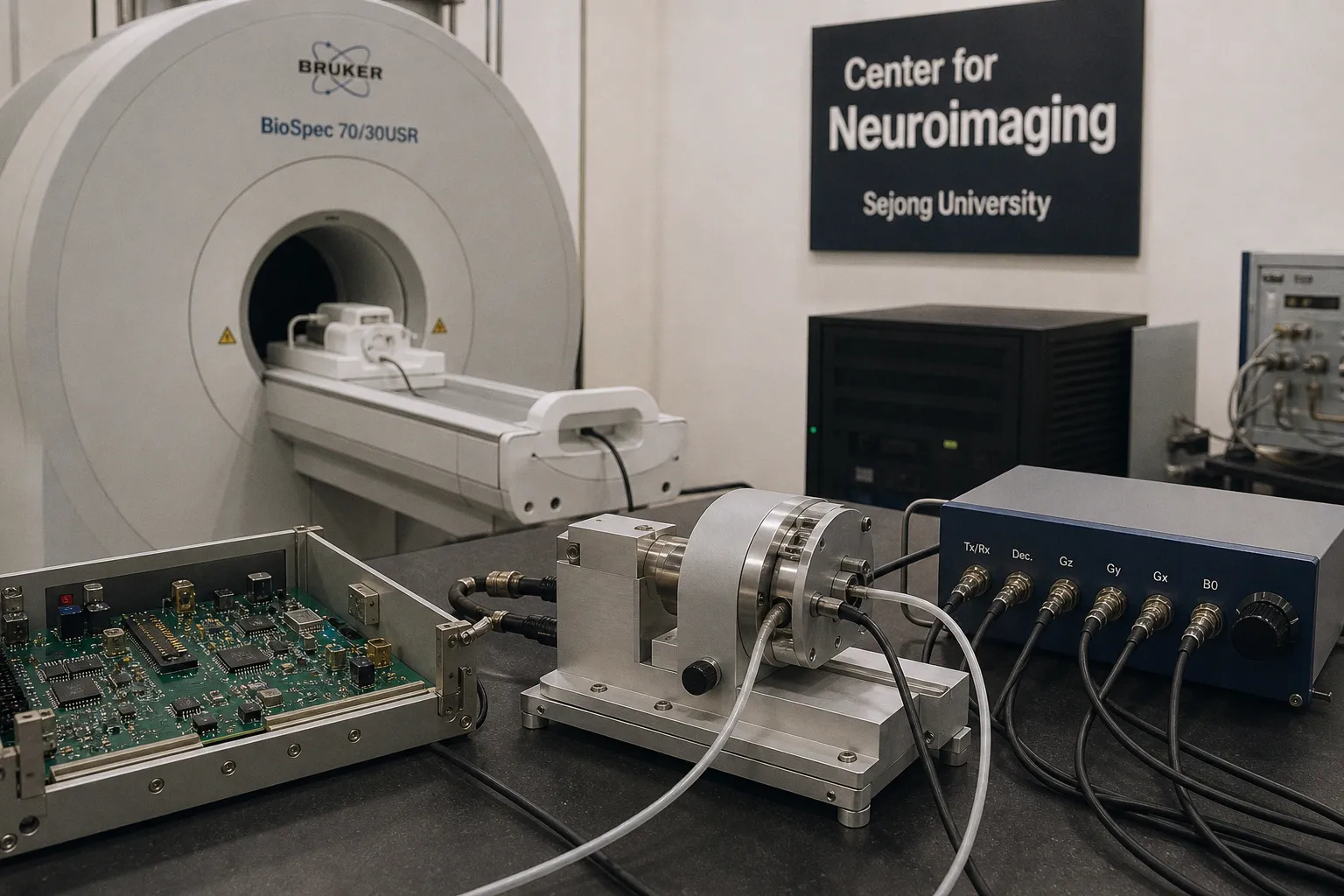
A hierarchical optimization framework indexed through Sejong University and Elsevier couples adaptive appearance alignment with gradient-based registration and segmentation in a single pass. The evaluation mixed ABIDE, ADNI, PPMI, and OASIS — four public cohorts with different scanner vendors, protocols, and annotation densities — and was benchmarked under limited annotations and changing imaging styles. The implication is direct: appearance and geometry cannot be optimized sequentially when acquisition style drifts across sites. Joint optimization is the new operational floor for cross-cohort analysis, and the cross-species map will inherit the same constraint the moment it is evaluated on more than one scanner vendor.