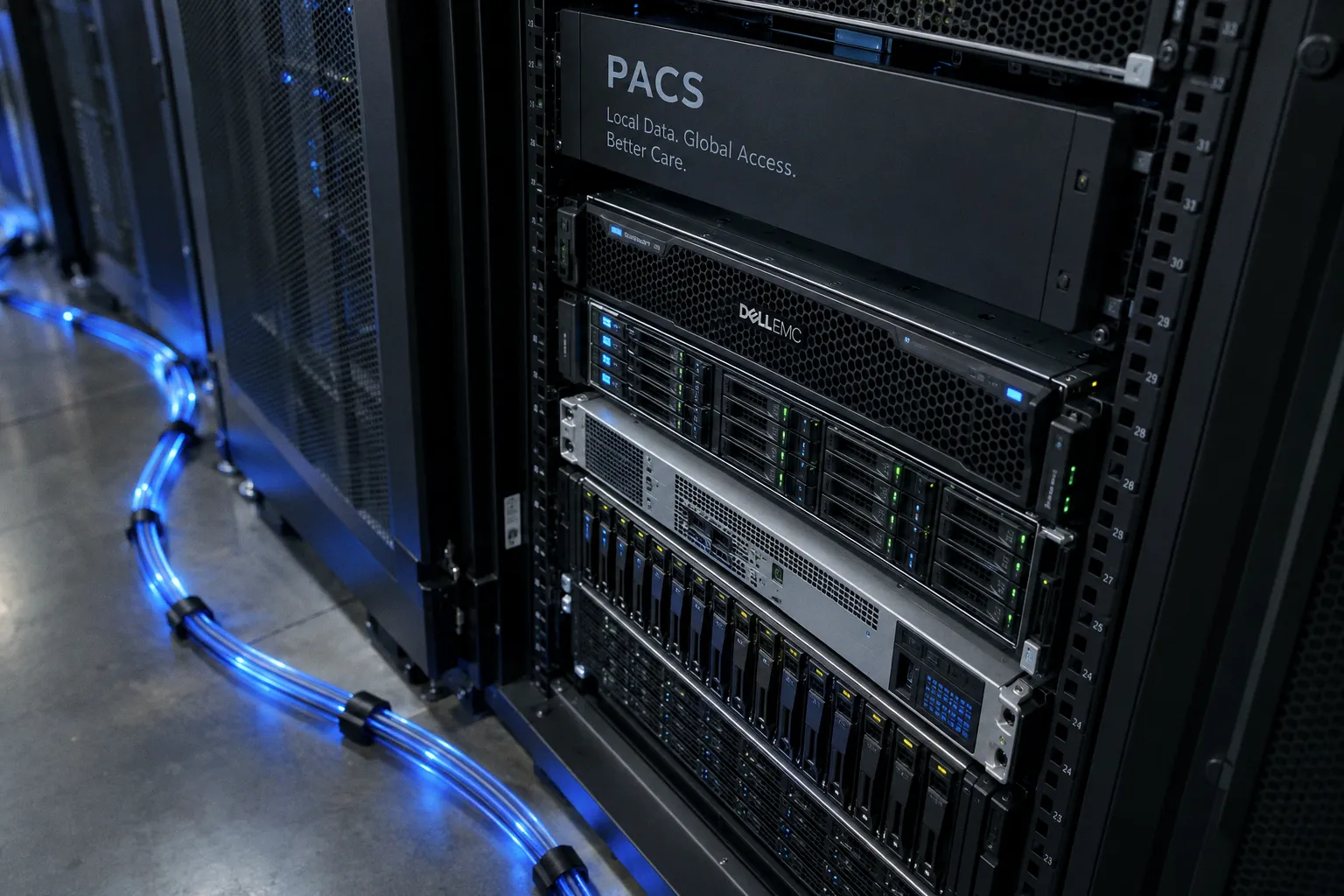
Move that same workload to a vendor-neutral cloud PACS and the five-year total cost of ownership drops to roughly $300,000–$600,000. That is a 30% to 50% reduction. It is not a rounding error. It is the difference between hiring one more radiologist and not.
That number does a lot of work in vendor decks. And it is not wrong. It is just incomplete.
The Economic Reality of Imaging Infrastructure: TCO Analysis
The cloud TCO advantage is real, but it is conditional. It assumes a single-site or modest multi-site practice without sunk-cost datacenter hardware already on the books. Hardware depreciation curves, storage refresh every three to four years, SAN license renewals, backup infrastructure, and the network engineering FTE to keep it all breathing — those are the line items that quietly crush the on-premise ledger. Cloud PACS converts most of those capital expenses into operating expenses and lets someone else's SRE team handle the 3 a.m. pager.
There is a quieter line item the cloud model does not erase: data migration. Most vendors quote a one-time migration cost of roughly $10,000 to $50,000, and that is for the happy path — clean DICOM, working HL7 feeds, an RIS that actually talks back. Anyone who has migrated an archive assembled across two decades of vendor acquisitions knows the happy path is folklore. Plan for the upper end of that range if your archive predates DICOMweb or if your priors live on a tape library that nobody trusts anymore.
| Cost Driver | On-Premise PACS (5-yr, ~50k studies/yr) | Cloud PACS (5-yr, ~50k studies/yr) |
|---|---|---|
| Servers, SAN, switching, refresh | $180,000–$320,000 | Minimal (edge gateway only) |
| Storage capacity and growth | $120,000–$260,000 | $90,000–$180,000 |
| Software licenses and support | $140,000–$280,000 | $120,000–$240,000 |
| IT staffing, networking, security | $120,000–$240,000 | $60,000–$120,000 |
| One-time data migration | — | $10,000–$50,000 |
| Indicative 5-year total | $600,000–$1,200,000 | $300,000–$600,000 |
The table is a planning instrument, not a quote. Your bandwidth costs, your compliance overhead, and your local labor market will move every row.
A cloud PACS does not eliminate your server closet. It just relocates it.
Latency and Performance: The Role of Edge Gateways in Neuroimaging
The most persistent myth in the cloud-PACS conversation is that a reading room somehow stops needing local infrastructure. It does not. A 3D MR neuro series — the kind that takes twelve seconds to scroll on a workstation with a warm local cache — can take forty-five seconds to a minute and a half when pulled across a WAN link from a cold object store. That is the difference between a useful study and a study the radiologist parks in the queue for later.
The industry's response is the edge gateway. A hybrid PACS architecture caches roughly 30 to 60 days of recent imaging locally while pushing older studies into cloud archival storage. The radiologist never knows where the study physically lives; the PACS application handles the routing transparently. This is not a hack. It is the actual production pattern. Vendor-neutral cloud PACS deployments use these local access devices and edge gateways to accept DICOM commands such as C-STORE and convert or route the data to cloud microservices running on platforms like AWS.
The architectural detail matters because it shifts the procurement conversation. You are not buying "cloud" or "on-premise." You are buying an edge gateway with a cloud-backed archive. That edge device is the same hardware performing DICOM ingestion from the scanner, so it is also your single point of failure for modality integration. Redundancy is not optional — it is the difference between a quiet Tuesday and a cancel-the-clinic Wednesday.
For teleradiology, where the reader is half a continent away from the source scanner, the edge gateway also becomes the compression point. Lossy compression of a 1,500-slice neuro MR study across a residential broadband link is where the diagnostic-quality conversation gets uncomfortable. Worth raising with the vendor before the contract is signed, not after the first callback from a frustrated reader.
Interoperability Standards: Bridging DICOM, HL7, and Cloud Microservices
The reason hybrid works at all is a small, unglamorous accomplishment of the standards committees. DICOM handles image metadata and transfer; HL7 and FHIR handle patient demographics, orders, and results between the RIS, the EHR, and the imaging platform. In a modern stack, ADT messages keep patient identity synchronized across systems, ORM messages ferry orders, and ORU results return the report.
The handshake is real, and it mostly works. The catch is that "mostly works" in 2026 usually means your integration engine is doing more translation work than it was designed for, and your vendor's reference implementation was tested against a three-year-old version of your EHR.
Standards promise interoperability. Operations deliver integration debt.
Cloud-native PACS platforms expose this in a particularly annoying way. The on-premise RIS-to-HL7 bridge that has functioned fine for a decade does not survive contact with a microservices backend that expects FHIR resources instead of HL7 v2 segments. Most cloud PACS vendors now ship with adapters, but the adapters are the integration work you thought you were outsourcing. Budget for it, and budget honestly.
There is a quieter issue worth naming: DICOM C-STORE does not natively support resumable transfer. A 4 GB neuro study that fails at the 97% mark because of a brief link blip will restart from zero in many vendor stacks. This is solvable at the edge gateway with deduplication and chunked upload — but it is solvable, not solved. Ask the vendor for the recovery behavior before the procurement memo is finalized.
Security and Compliance in Distributed Neuroimaging Environments
The cloud sales pitch treats "we are in the cloud" as if it were a security control. It is not. It is a deployment model. A HIPAA-aligned cloud deployment still requires the same BAA architecture, the same access controls, the same audit logging, and the same de-identification pipeline that an on-premise stack requires — just spread across more network paths and more vendor accountability boundaries.
The genuinely better security posture of a mature cloud PACS is rarely the encryption or the uptime promise. It is the immutability of the storage tier and the geographic redundancy. Object stores with object lock and versioning protect against the ransomware scenario that has become the single most expensive operational risk in mid-sized radiology practices. A 30-day local cache that gets encrypted by an attacker is recoverable from cloud; the inverse — a cloud archive locked by a compromised admin key — is recoverable only as fast as your second cloud region allows.
The compliance overhang that does not get enough airtime is research data egress. Neuroimaging research increasingly requires de-identified export to collaboration sites, often across institutional and national boundaries. A cloud PACS with FHIR-native de-identification APIs makes this tractable. An on-premise PACS turns it into a manual export queue that compliance officers would prefer not to discuss. This is one of the cleaner cases where the architectural choice is also the workflow choice — and where the headline TCO comparison quietly stops being the whole story.
Strategic Migration: Balancing Legacy Assets with Scalable Cloud Archiving
The honest answer to the on-premise versus cloud PACS storage question for neuroimaging research is "yes." Hybrid is not a compromise position invented by vendors to keep one foot in each door. It is the architecture that matches how radiology actually operates: hot studies close to the reader, cold studies close to the budget, with the same DICOM and HL7 surface on both sides.
Industry data puts public cloud adoption across surveyed healthcare organizations at over 80%, with most still maintaining significant on-premise assets. Worth noting the nuance: "public cloud provider" is not the same as "cloud-native PACS." The scanner console, the modality gateway, the EHR integration, and the VNA cache are still local. The cloud layer is the archive, the disaster recovery target, and the teleradiology front door.
If you are sitting on an on-premise archive that has been paid for and amortized, the rational move is rarely to forklift it into the cloud. Keep the warm tier local, push new studies into a cloud archive on a phased schedule, and let the next hardware refresh cycle decide the rest. For a greenfield site, cloud-native PACS with an edge gateway is the lower-risk choice. For a multi-hospital enterprise with sunk datacenter investment and stable bandwidth, the math gets harder than the vendor will ever put in writing.
There is one final friction point the brochures do not print. Egress fees on research-grade data exports can move total cloud ownership costs meaningfully, especially for institutions running multi-site neuroscience collaborations. Vendor-specific egress pricing is opaque by design, and it is one of the line items your finance team will discover in year two rather than year one.
The Reading Room Wins When Architecture Stops Being a Debate
The boring truth about on-premise versus cloud PACS storage is that the reading room does not care which side won the architecture argument. The reading room cares whether the current study loads, whether the priors from the other hospital load, and whether the 3D MPR finishes before the radiologist moves on to the next case. Architecture is upstream of all of that, and the architects who make it work are the ones who picked the boring hybrid path instead of the shiny single-vendor story.
Spend the cloud savings on the radiologist. Not on the vendor's quarterly earnings call.