A radiologist may interpret 50 to 100 studies in a day. The PACS does not care. It will still make the user wait for the priors, hide the relevant worklist behind three menus, or fail an API handshake because one system expects a different version of the same standard.
That is the real argument behind monolithic PACS vs deconstructed enterprise imaging. It is not a clean contest between old software and modern architecture. It is a choice between two kinds of operational pain: the concentrated dependency of a single-vendor platform, or the distributed friction of a modular ecosystem.
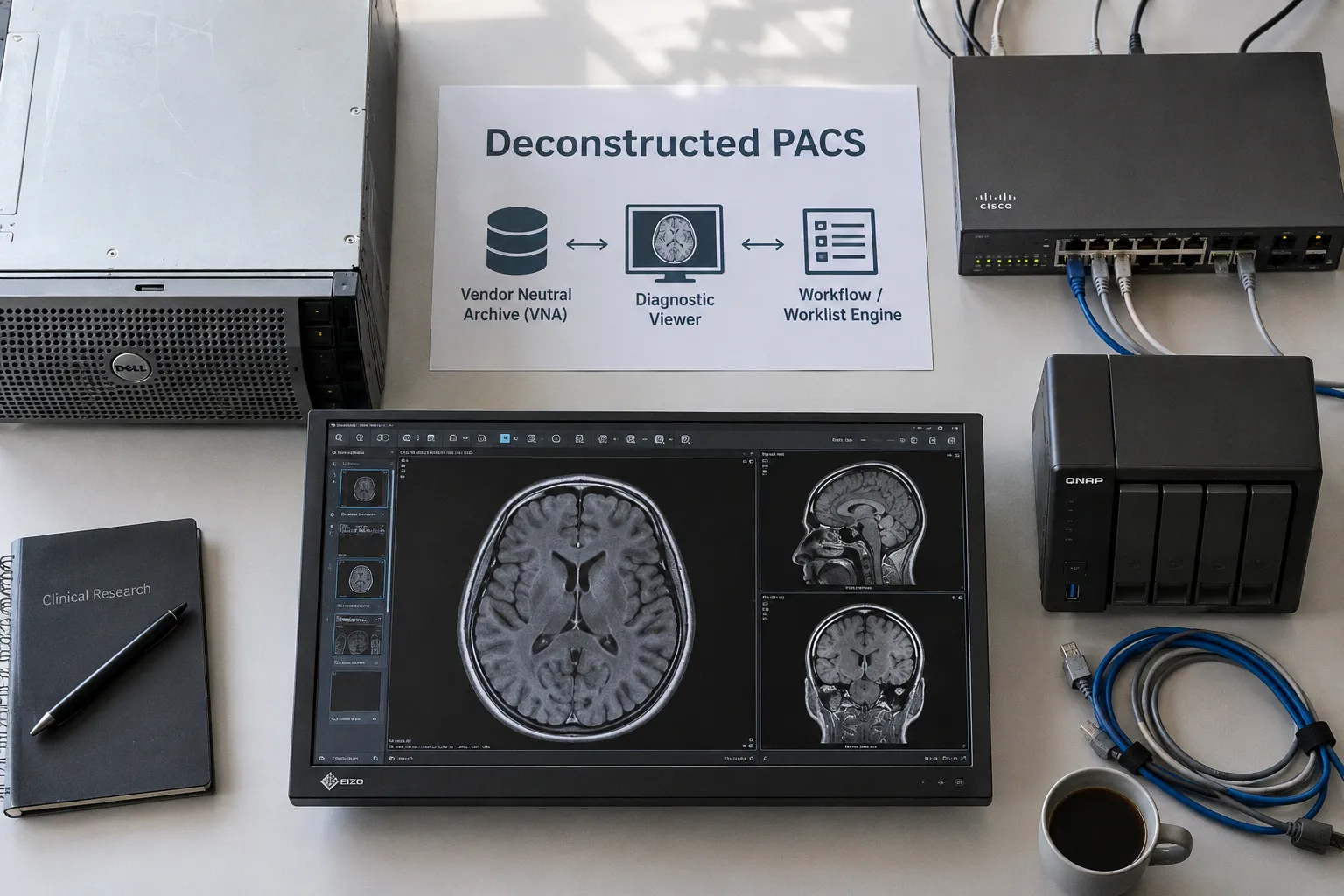
A monolithic PACS bundles the archive, diagnostic viewer, and workflow engine into one proprietary environment. Deconstructed enterprise imaging separates those functions—typically into a Vendor Neutral Archive, a diagnostic viewer, and an independent workflow or worklist engine. The first model reduces the number of moving parts. The second gives an institution more freedom to change those parts.
Freedom is useful. So is not having six vendors involved when a study takes eight seconds to open.
The architectural split: one product or three systems
The monolithic PACS model is easy to describe because the vendor has already made most of the architectural decisions. The image archive, viewer, worklists, routing rules, and often reporting functions are designed to operate as one platform. Interfaces may exist, but the center of gravity remains inside the vendor’s stack.
That creates a familiar operational pattern:
- The archive stores the studies.
- The viewer retrieves and displays them.
- The workflow engine assigns, prioritizes, and tracks work.
- The vendor controls the integration logic connecting those components.
For a hospital with a relatively contained imaging environment, this can be a rational arrangement. There is one primary escalation path, one commercial relationship, and fewer opportunities for the archive, viewer, and worklist to disagree about what a study is or where it should go.
The problem arrives when the organization outgrows the assumptions built into that platform. A cardiology department wants a different viewer. Neurology needs advanced MRI analysis. A regional network acquires another hospital running a competing PACS. The oncology service wants longitudinal access across modalities and sites. Suddenly, the “integrated” system begins to mean “integrated as long as nobody changes anything.”
The deconstructed architecture takes the opposite position. Storage, visualization, and orchestration become separate services:
1. VNA — the Vendor Neutral Archive provides a central storage layer intended to reduce dependence on a particular PACS database or proprietary archive.
2. Diagnostic or universal viewer — the interface used for primary interpretation, specialty review, or enterprise access.
3. Workflow engine — the system that manages worklists, routing, prioritization, assignment, escalation, and status.
The components can be sourced from different vendors and replaced independently. That is the selling point. It is also the beginning of the integration bill.
Deconstruction does not remove complexity. It moves complexity from the product into the architecture—and therefore into your team.
The distinction matters because PACS is no longer just an image viewer with a disk attached. It is part of a larger enterprise imaging environment that includes RIS, reporting systems, modality worklists, teleradiology services, identity management, analytics, AI tools, and clinical applications. Each connection becomes a potential bottleneck, especially when the organization assumes that DICOM or HL7 will make the entire system behave like a plug-and-play appliance.
Standards help. They do not perform the integration for you.
What monolithic PACS gets right
Monolithic PACS is often criticized as though it were an architectural mistake that survived by accident. That is too simplistic. The model persists because it solves several real problems rather well.
Fewer handoffs at the center
When the archive, viewer, and worklist engine come from one platform, the vendor controls the internal data flow. A study can be created, stored, routed, opened, and marked complete within a relatively consistent transaction model.
That reduces the number of points where metadata can be transformed incorrectly. Accession numbers, patient identifiers, procedure descriptions, timestamps, and status flags are not crossing as many organizational boundaries. If something fails, the support team may still blame the network, the modality, or the hospital’s interface engine—but at least the vendor knows its own internal plumbing.
This is not glamorous. It is useful.
Lower administrative overhead
A single-vendor PACS can simplify procurement, contract management, patch coordination, and escalation. The institution may still have several adjacent systems, but the core imaging workflow has one accountable supplier.
That matters for smaller imaging organizations. A deconstructed PACS architecture assumes the hospital can manage multiple roadmaps, service-level agreements, upgrade schedules, interface changes, and security reviews. If the internal team consists of one PACS administrator and a part-time infrastructure engineer, “best of breed” can become “best of luck.”
Predictable user experience
Radiologists develop habits around navigation, hanging protocols, priors, measurements, dictation, and worklist behavior. A monolithic suite can keep these functions in one interface, even if the result is not perfect.
The interface may be dated. It may have a button that appears to have been designed during the fax machine era. But if it loads reliably and the radiologist can move through the list without excessive click fatigue, users will often tolerate more ugliness than an executive committee expects.
Throughput is not improved by visual polish alone. A sleek viewer that loses priors or makes the user authenticate twice is still a productivity problem wearing a modern coat.
Where the model becomes restrictive
The weakness of monolithic PACS is not simply that it is proprietary. It is that the archive, viewer, and workflow engine become strategically inseparable.
Replacing the viewer may require a broader platform migration. Adding a specialized neuroimaging application can involve custom integration. Consolidating multiple hospitals may force the organization to normalize data inside one vendor’s preferred model. The system is operationally simple until the institution needs it to behave differently.
That creates enterprise imaging vendor lock-in. The hospital may technically own the data, but practical control depends on how easily that data can be accessed, exported, reindexed, reconciled, and used by another system. Ownership in a contract and portability in production are not the same thing.
Why deconstructed PACS is attractive to large imaging networks
The deconstructed PACS architecture gained attention because imaging environments stopped being neatly contained inside one department. A health system may have multiple hospitals, outpatient centers, emergency departments, specialty clinics, research repositories, and external teleradiology partners. Each site may generate studies with different workflows and different legacy systems.
A modular architecture gives the organization a way to separate long-lived infrastructure from replaceable applications.
The VNA can become the durable storage layer. Viewers can be selected for different clinical contexts. A workflow engine can coordinate studies across locations rather than forcing each facility to behave like an isolated PACS island.
More than 400 million radiology studies were processed for primary interpretation under a deconstructed PACS strategy between 2014 and 2018 in U.S. imaging organizations. That scale does not prove that modular architecture is universally better. It does show that the model moved beyond conference slides and into serious production environments.
The strongest case for deconstruction usually appears in organizations with several of the following conditions:
- Multiple PACS instances created through mergers or acquisitions.
- A need to support radiology, cardiology, pathology, or other imaging specialties through a broader enterprise platform.
- A strategy to use different viewers for diagnostic, clinical, research, and referral workflows.
- Significant investment in cloud deployment or distributed reading.
- A requirement to preserve access to images while replacing workflow or visualization components.
- An internal team capable of managing vendor-neutral interfaces rather than merely maintaining one PACS application.
The modular approach is especially compelling when the institution expects change. If the imaging environment will remain stable for a decade, the value of replaceability may be theoretical. If the organization is acquiring hospitals, adding AI tools, moving selected services to the cloud, and restructuring teleradiology coverage, replaceability becomes a form of operational insurance.
The price of flexibility is integration work
The vendor pitch for deconstructed imaging usually focuses on choice. Choose the best viewer. Choose the best archive. Choose the workflow engine that matches your reading model. Avoid being trapped in a single roadmap.
All true. None of it is free.
A modular environment creates more API handshakes, more interface ownership, and more opportunities for latency. The workflow engine may know that a study exists before the VNA has completed ingestion. The viewer may open the current series but not retrieve priors from a legacy archive. The RIS may show an exam as complete while the workflow engine still considers it pending. The AI result may be available in one application but not visible in the diagnostic viewer when the radiologist actually needs it.
These are not hypothetical architectural curiosities. They are the small failures that accumulate into a slow reading room.
The interface burden
DICOM supports image exchange, but real-world interoperability depends on implementation details: tags, modality behavior, routing rules, compression, transfer syntax, identifiers, and the way each system handles incomplete or corrected data.
HL7 and FHIR can support broader clinical integration, but the presence of an interface standard does not guarantee semantic agreement. One system’s “final” may be another system’s “preliminary.” One application may treat an amended report as a new event; another may update the original record. The API handshake succeeds, and the workflow still fails.
A deconstructed architecture needs explicit ownership for questions such as:
- Which system is authoritative for patient identity?
- Which system owns the accession number?
- Where is the canonical study status maintained?
- How are corrected demographics reconciled?
- What happens when a study is split, merged, or re-ordered?
- Which system triggers priors retrieval?
- How are failed transfers detected and replayed?
- How are downtime procedures recorded and reconciled later?
If nobody owns those decisions, the hospital has not built a platform. It has assembled a collection of optimistic assumptions.
Latency is a clinical workflow issue
Interface latency is often discussed as an infrastructure metric. In the reading room, it becomes a cognitive tax.
A few seconds added to each study can disrupt hanging protocols, delay priors, and encourage workarounds. A radiologist may open a second viewer, search manually, or bypass a workflow rule because waiting is less painful than trusting the system. That behavior creates more inconsistency, not less.
The relevant question is not whether the deconstructed system can open an MRI study. It is whether it can open the right MRI study, with the right priors, the right clinical context, and the right post-processing results, at the moment the radiologist needs them.
That is a much higher bar than “the DICOM association succeeded.”
More vendors means more coordination
A monolithic platform concentrates risk in one supplier. A deconstructed platform distributes risk across several suppliers and the interfaces between them.
When a problem appears, each vendor may have a technically reasonable explanation:
- The VNA received the study but did not own the routing rule.
- The viewer requested the series but received an incomplete response.
- The workflow engine issued the work item but the RIS did not update the status.
- The interface engine delivered the message but mapped a field differently after an upgrade.
- The network met its availability target even though the application was unusably slow.
The hospital needs an integration owner with enough authority to resolve the problem across contract boundaries. Otherwise, the organization gets a multi-vendor architecture and a single-vendor support experience: nobody is responsible.
A practical comparison
The choice is not about which architecture wins in theory. It is about which failure mode the organization can operate without damaging throughput, data continuity, or clinical trust.
| Dimension | Monolithic PACS | Deconstructed enterprise imaging |
|---|---|---|
| Core design | Archive, viewer, and workflow engine bundled into one proprietary platform | VNA, viewer, and workflow engine operate as separate components |
| Implementation | Usually simpler at the center, with fewer primary integration points | More complex, requiring interface design, orchestration, monitoring, and governance |
| Vendor dependency | High dependency on one vendor’s roadmap and data model | Lower dependency on one vendor, but higher dependence on integration quality |
| Viewer strategy | Often tied closely to the PACS platform | Viewers can be selected or replaced independently |
| Storage strategy | Archive commonly embedded in the PACS ecosystem | VNA can serve as a shared storage layer across applications and specialties |
| Workflow changes | May require vendor customization or broader platform changes | Workflow engine can be adapted independently, if interfaces are reliable |
| Troubleshooting | Fewer parties, but deeper dependence on the primary supplier | More parties and clearer component boundaries, but harder cross-vendor escalation |
| Interoperability | Can be adequate inside the vendor’s ecosystem, restrictive outside it | Designed for broader interoperability, but vulnerable to metadata and status mismatches |
| Migration risk | Migration may be disruptive because functions are tightly coupled | Components can be migrated separately, but data and workflow dependencies must be mapped |
| Best fit | Stable environments prioritizing simplicity and consolidated support | Complex, growing networks prioritizing flexibility and long-term replaceability |
The table is not a procurement decision. It is a reminder that every advantage has a corresponding operational invoice.
The VNA question: archive or another abstraction layer?
The “VNA vs monolithic PACS” discussion often becomes overly tidy. The VNA is presented as the neutral foundation and the monolithic PACS as the proprietary past. In practice, a VNA can improve portability while introducing another layer that must be managed, monitored, and paid for.
A VNA is valuable when it genuinely provides a durable, accessible repository across applications and sites. It should support consistent retrieval, metadata governance, lifecycle management, and controlled access for the systems that need it. It should also make future migration less dependent on one viewer or workflow vendor.
But neutrality is not achieved by putting the word “neutral” in the product name. The archive still has data models, APIs, routing behavior, security controls, performance limits, and preferred integration patterns. A VNA that requires extensive proprietary configuration may simply relocate lock-in from the PACS database to the enterprise archive.
The practical test is portability under pressure. Can the organization retrieve complete studies with usable metadata? Can it support a new viewer without months of custom work? Can it reconcile patient identity across acquired facilities? Can it continue operations during a component outage? Can it export data in a way that another system can actually consume rather than merely accept on paper?
If the answer depends on a professional-services engagement every time a new application is added, the architecture is less neutral than advertised.
Workflow integration is where the strategy succeeds or fails
Storage and viewing receive most of the architectural attention. Workflow is where radiologists feel the consequences.
An enterprise imaging strategy should define how studies enter the system, how they are prioritized, how they move between queues, and how completion is communicated to the rest of the clinical environment. It should account for routine work, urgent studies, subspecialty assignment, addenda, outside examinations, corrected demographics, downtime, and unclaimed work.
A workflow engine can be more flexible than the worklist embedded in a monolithic PACS. It can coordinate reading across sites and route cases according to subspecialty, service level, geography, or staffing. But flexibility can also produce a forest of rules that nobody understands after the original implementation team leaves.
A useful workflow design makes the following visible:
- The event that creates a work item.
- The system that owns assignment.
- The conditions that change priority.
- The point at which a study is considered in progress.
- The event that marks interpretation complete.
- The handling of rejected, duplicated, or amended studies.
- The escalation path for unassigned or stalled work.
- The monitoring signal that proves the transaction completed.
This is where click fatigue and throughput intersect. A workflow may be logically correct and still fail the reading room if users must acknowledge the same case in multiple applications. Every extra status update is a chance for divergence. Every manual reconciliation step is a small tax applied to every study.
At 50 to 100 studies per day, small taxes become a staffing problem.
The best-of-breed strategy only works when the workflow is better than the compromise it replaced.
Cloud deployment changes the shape, not the problem
Cloud-based MRI viewers and enterprise imaging platforms can improve geographic access, simplify elastic capacity, and support distributed reading. They can also make latency, identity, security, and data movement more visible.
A cloud viewer is not automatically a cloud workflow. If the archive is in one environment, the workflow engine in another, and the RIS remains on premises, the user experience depends on the network path between them. The architecture may be technically distributed while the radiologist experiences it as one long loading spinner.
Cloud deployment also raises practical governance questions:
- Where are diagnostic images stored and processed?
- How are users authenticated across institutions?
- How are service accounts and API credentials rotated?
- How is MRI data de-identified for research or secondary use?
- What happens when connectivity to the cloud service is degraded?
- Are audit events available across every component?
- How are images and reports recovered after an outage?
- Which data flows are required for clinical care, and which are optional?
Medical data security is not a separate layer that can be added after implementation. It is a property of the entire chain: modality, interface engine, archive, viewer, identity provider, workflow system, cloud service, and downstream application.
The same applies to regulatory compliance. A modular architecture does not transfer accountability to the vendors. The institution still has to understand where protected health information moves, how access is logged, how data is retained, and how changes are validated.
The migration trap: replacing the PACS is rarely one project
The phrase “PACS replacement” makes the work sound smaller than it is. In a monolithic environment, the PACS may contain years of workflow rules, hanging protocols, user preferences, routing logic, modality mappings, report links, and informal workarounds that were never documented.
A deconstructed migration can separate those functions, but it cannot make them disappear. The organization must discover what the old system was doing, including the things nobody thought counted as configuration.
The migration usually has at least four distinct tracks:
1. Data migration and access
Historical studies must remain findable, clinically usable, and correctly associated with the patient and encounter. Moving files is not the same as preserving access.
2. Workflow reconstruction
Existing worklists, priorities, assignments, and exception paths need to be mapped into the new workflow engine. The undocumented rule is often the one that keeps the emergency department functioning at 2 a.m.
3. Identity and metadata reconciliation
Patient identifiers, accession numbers, study descriptions, and site-specific conventions need consistent handling across facilities and applications.
4. User transition
Radiologists and technologists must learn new navigation patterns while continuing to produce clinical work. Training that focuses only on features misses the real issue: how many decisions and clicks are required to complete a study.
A phased migration can reduce risk, but it can also create a hybrid environment that lasts longer than planned. During that period, the organization may operate two viewers, several archives, duplicated worklists, and overlapping routing rules. Hybrid is not a strategy unless somebody defines how and when it ends.
How to decide without buying the demo
A vendor demonstration will show a clean study, a cooperative modality, a fast network, and a user who already knows where every button is. Production is less polite.
The evaluation should begin with the hardest workflows, not the prettiest ones. Use real operational cases: outside priors, corrected demographics, incomplete series, urgent add-ons, failed transfers, amended reports, multi-site assignments, and MRI studies requiring post-processing or research access.
The decisive questions are practical:
- How many applications must the radiologist open to complete one study?
- Does the viewer retrieve priors automatically, and from where?
- What happens when a series arrives late?
- Can the workflow engine recover from a failed interface transaction?
- Which system displays the authoritative study status?
- How are duplicate studies prevented from entering the worklist?
- Can the organization monitor queue age, interface latency, failed transfers, and unassigned work?
- What happens during a VNA outage or viewer outage?
- Can the institution replace one component without rebuilding the others?
- How much of the integration depends on custom code rather than documented interfaces?
- Who owns the incident when every component reports healthy but the workflow is broken?
A short pilot should measure time to open, time to retrieve priors, failed transaction recovery, user clicks, and the number of manual workarounds. Not every metric needs a dramatic baseline. The point is to expose friction before it is multiplied across thousands of studies.
A sensible procurement team should also ask for an exit plan before signing the entry plan. Data export, metadata portability, interface documentation, configuration ownership, and termination assistance are not hostile questions. They are what enterprise architecture looks like after the sales team stops presenting.
Which model fits which institution?
There is no universal winner in the monolithic PACS vs deconstructed enterprise imaging debate.
A monolithic platform may be the better decision for an organization with a stable footprint, limited internal integration capacity, and a strong preference for consolidated support. It can provide operational simplicity and predictable ownership, particularly when the institution does not need to coordinate several independent viewers and workflow systems.
A deconstructed model is more compelling for a growing health system with multiple sites, competing legacy platforms, broader enterprise imaging ambitions, and the resources to manage integration as a permanent capability. The benefit is not merely the ability to choose different products. It is the ability to change one part of the imaging environment without treating every other part as collateral damage.
But a modular platform should not be selected because “best of breed” sounds sophisticated. If the organization lacks interface monitoring, identity governance, vendor management, and workflow ownership, deconstruction may increase operational risk faster than it increases flexibility.
The most realistic middle ground may be a deconstructable suite: a primary vendor provides a coherent operational core while allowing selected components to be replaced or integrated over time. This does not eliminate vendor dependency, but it can avoid the worst version of lock-in without forcing the hospital to become an integration company overnight.
The decision is really about tolerance for change
Monolithic PACS optimizes for cohesion. Deconstructed enterprise imaging optimizes for replaceability. One concentrates complexity inside a vendor-controlled platform; the other distributes it across interfaces, teams, and contracts.
Neither architecture is automatically modern, efficient, or safe. The right question is less flattering and more useful:
Which kind of complexity can the institution govern every day?
If the answer is centralized support and limited change, monolithic PACS may remain the sensible choice. If the answer is a dedicated integration function, strong data governance, and a health system that expects continued growth and specialization, deconstructed imaging can provide the flexibility that a tightly coupled platform cannot.
The mistake is treating architecture as a purchasing category. It is an operating model. The archive, viewer, and workflow engine are only the visible pieces. Underneath them sit interface ownership, identity management, latency budgets, security controls, monitoring, migration planning, and the exhausted radiologist trying to finish the list before the next batch arrives.
Choose the architecture that makes those realities manageable. The brochure will survive either decision. The reading room has to live with it.