Every stage can stall. A cloud-based MRI viewer may have abundant compute and still feel slow. An on-premise PACS may sit beside the scanner and still degrade under poor storage design, overloaded archives, or badly configured remote access.
The useful comparison is not simply cloud based MRI viewer vs on premise PACS. It is local retrieval against distributed retrieval. Dedicated LAN against WAN variability. Preloaded data against progressive delivery. Fixed infrastructure against an architecture that must tolerate packet loss, cache intelligently, and preserve diagnostic interaction while the remainder of a multi-gigabyte study is still arriving.
For radiologists, the visible symptom is familiar: a series opens, the first images appear, and scrolling becomes intermittent. For developers, the cause is less visible. It may be DICOM query latency, inefficient transfer syntax handling, server-side rendering, browser memory pressure, cache misses, or a workflow engine that blocks image delivery behind metadata validation. The display is where the problem becomes apparent. The fault can exist several layers below it.
The physics of latency: LAN performance versus WAN constraints
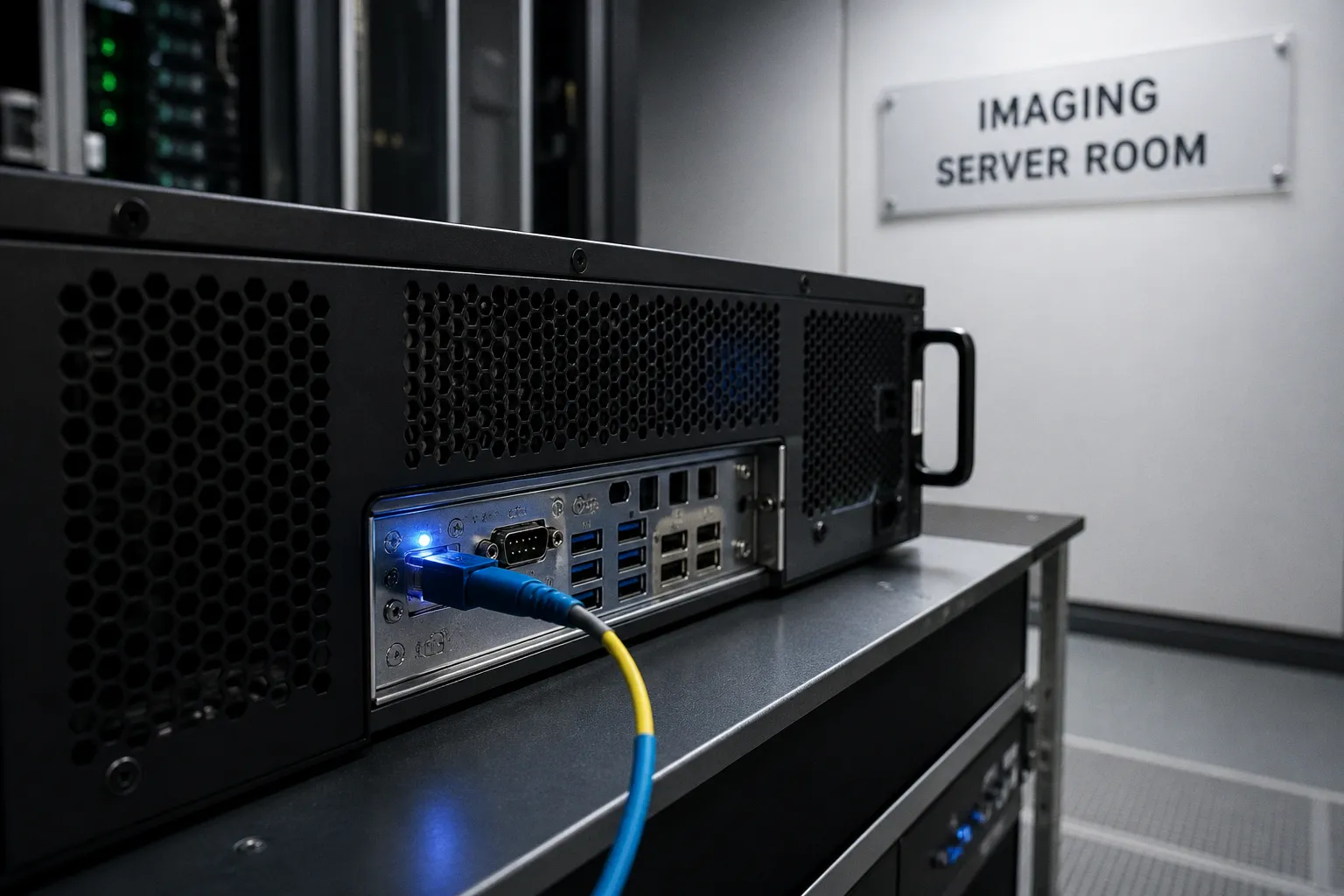
An on-premise PACS stores imaging data on physical servers within the facility’s own data center. When the reading workstation and archive communicate across a dedicated high-speed local area network, retrieval latency is typically measured in milliseconds. That is a strong baseline. The data does not need to cross a public network. It does not depend on an external identity provider, cloud routing path, or geographically distant storage tier.
Large MRI studies benefit from this proximity. A volumetric series may contain thousands of images, multiple orientations, diffusion data, perfusion sequences, susceptibility-weighted acquisitions, and derived maps. The study is not a small document. It is a collection of DICOM objects with different matrix sizes, compression states, metadata payloads, and reconstruction requirements. Pulling the complete examination from local storage can be operationally efficient when the archive, workstation, and network are engineered as one system.
But local does not mean instantaneous. Storage contention can degrade retrieval. Concurrent reads can saturate a disk array or network interface. A server that performs compression, authorization, prior-study matching, and image conversion on the same resources used for delivery will yield inconsistent performance. The local PACS has a low physical distance to the reader. It does not automatically have low queueing delay.
The cloud introduces a different latency profile. The distance between the reader and the primary archive is variable. So is the route. Bandwidth is only one constraint. Round-trip time, packet loss, browser rendering, encryption overhead, session authentication, and the viewer’s request pattern all influence the time to first image and the time to interactive scrolling.
A naive cloud viewer requests the study as if it were a single file. That model performs poorly. A multi-gigabyte study must be transferred before meaningful interpretation begins, and the reader is forced to wait for a completion event that has little clinical value. A more competent viewer breaks the examination into usable units. It loads the selected series first, retrieves adjacent images progressively, and prioritizes the active viewport over inactive data.
This distinction matters. The relevant measurement is not merely archive-to-workstation transfer time. It is the time required to reach a stable diagnostic state:
- the correct patient and accession are identified;
- the target series is available;
- the first image renders;
- scrolling remains continuous;
- windowing, multiplanar reconstruction, and other interactions do not stall;
- priors can be retrieved without blocking the current examination.
A cloud platform that reduces time to first image but produces a broken scroll experience has not solved the problem. It has moved the delay.
Local PACS wins on physical proximity. Cloud PACS wins only when its delivery architecture prevents the reader from waiting for the entire study.
Why cloud rendering latency is an architectural problem
Cloud PACS performance depends on how the viewer distributes work between the archive, rendering service, browser, and local cache. There is no single cloud architecture. There are several.
Server-side rendering
In a server-side model, the cloud platform retrieves DICOM data, performs decoding and rendering remotely, and sends image frames or rendered tiles to the browser. The local device receives a display stream rather than the complete original dataset.
This can reduce browser memory pressure. It can also constrain interaction. Every change in window level, plane, slice position, or reconstruction state may generate another request to the rendering service. If the service does not maintain a warm session or predictive buffer, the viewer becomes sensitive to round-trip time.
Server-side rendering is attractive for controlled endpoint environments. The workstation does not need the same local processing capability. The platform can centralize updates and enforce a uniform rendering stack. But the model makes network continuity part of every interaction. A temporary increase in WAN latency can affect not just opening the study but active interpretation.
Client-side rendering
A browser or local component receives DICOM objects, decoded pixel data, or optimized image tiles and performs more of the rendering locally. Scrolling can become smoother once the relevant series is cached. The network is still required for retrieval, but fewer interactions need to return to the cloud.
This model places greater demands on the endpoint. Browser memory, GPU capability, JavaScript execution, and local storage policy become relevant. Security controls may limit persistent caching. Older workstations may not tolerate large volumes or complex multiplanar operations without performance degradation.
Client-side rendering can yield strong responsiveness after initial loading. It does not remove the initial transport cost. It also requires careful handling of data lifecycle. Cached pixels must be controlled, encrypted where appropriate, and removed according to the organization’s security policy.
Progressive loading and intelligent caching
Progressive loading changes the unit of delivery. Instead of treating a study as one undifferentiated object, the viewer identifies what the reader needs first. The active series is prioritized. Images arrive in sequence. Additional series and priors follow according to interaction patterns.
Intelligent caching extends this logic across sessions and locations. Recent studies can be retained close to the reader, while older examinations remain in the primary cloud archive. The cache may be local to a workstation, a reading room, an edge appliance, or a facility network. Its value depends on the prediction being correct. A cache that contains the wrong studies consumes storage without reducing retrieval time.
The implementation must also distinguish between metadata and pixels. Patient, accession, modality, series, and study information can often be retrieved rapidly and used to construct the worklist before the image payload is complete. That separation improves workflow visibility. It does not make the images available. A fast worklist with delayed pixels is still a delayed imaging workflow.
Zero-footprint web viewers
A zero-footprint viewer runs through a browser without a traditional installed client. This simplifies deployment across sites and can support tele-radiology access. It also shifts responsibility to browser compatibility, endpoint performance, identity management, and network behavior.
The term does not mean zero infrastructure. The platform still needs DICOM services, storage, rendering, audit controls, and integration with the radiology information system. It means the endpoint installation burden is reduced. That is operationally useful. It is not a latency guarantee.
A browser-based viewer can perform well when it uses progressive loading, intelligent caching, or client-side streaming. Without those mechanisms, the absence of a local client simply exposes the reader to the full WAN path.
The rendering pipeline is only one part of PACS integration
Latency is often blamed on the viewer because the viewer is where the delay is visible. In enterprise imaging, the full workflow includes systems that may never render an image.
A typical examination passes through modality worklist management, acquisition, DICOM storage, routing, archive indexing, study reconciliation, reporting, and distribution. The PACS must interact with the radiology information system. In larger deployments, the integration layer may also connect electronic health records, identity providers, analytics systems, and clinical decision-support tools.
DICOM handles the imaging objects and associated metadata. HL7 and FHIR can support broader clinical data exchange, depending on the deployment. These interfaces do not directly determine scroll performance, but failures in them can delay the study before image retrieval begins. A mismatched accession number, incomplete patient identity, or delayed order message can produce an apparent viewer problem that is actually a workflow synchronization failure.
Enterprise imaging platforms therefore need separate performance budgets for separate events:
| Workflow event | Primary constraint | Typical architectural response |
|---|---|---|
| Worklist population | RIS/PACS messaging and indexing | Asynchronous metadata ingestion and reliable reconciliation |
| Time to first image | Network path, archive access, rendering startup | Progressive loading and prioritized series retrieval |
| Continuous scrolling | Request pattern, browser or server rendering, cache state | Prefetching, local caching, client-side rendering, or warm sessions |
| Prior-study comparison | Archive distance and study volume | Edge cache, intelligent prefetching, tiered storage |
| Multiplanar or 3D interaction | Compute placement and data availability | Client GPU processing or dedicated cloud rendering services |
| Remote reporting | WAN stability, authentication, VPN path | Native web access, optimized routing, session persistence |
| Long-term availability | Archive scalability and disaster recovery | Cloud primary archive, replicated storage, or hybrid deployment |
This separation prevents a common procurement error. A vendor may demonstrate rapid opening of a small study while leaving the difficult operations unmeasured. The clinically relevant test is not a polished first screen. It is a complete interaction sequence across representative MRI examinations.
The test set should include high-resolution structural imaging, diffusion series, dynamic acquisitions, susceptibility-sensitive sequences, and studies with numerous prior examinations. A platform that yields good performance for a single routine series may degrade when the reader opens the full examination, loads priors, and performs multiplanar review.
Hybrid PACS: local speed with cloud-scale storage
The hybrid model exists because the two extremes impose different constraints. Local infrastructure is strong at immediate retrieval over a facility LAN. Cloud infrastructure is strong at scalable archive capacity, remote accessibility, and disaster recovery design. A hybrid PACS places fast-access data near the reader while maintaining a primary or long-term cloud archive.
The local component may be a cache or edge appliance rather than a complete independent archive. Recent studies can be retained for rapid access. Older examinations remain available from cloud storage. The architecture can also route newly acquired studies through local infrastructure first, allowing clinical work to continue during temporary WAN degradation.
This is not a free compromise. The cache policy becomes operationally important. If it retains only the most recent studies, a follow-up examination with an older baseline may require a cloud retrieval at the moment of interpretation. If it retains too much, storage and synchronization costs increase. The policy must reflect actual reading patterns, not a generic retention assumption.
A competent hybrid deployment answers several specific questions:
1. Which data is cached?
Recent studies, priors for scheduled patients, frequently accessed oncology cohorts, and examinations from high-volume modalities may justify different policies.
2. Where is the cache located?
A reading-room appliance, facility data center, or regional edge node produces different network paths and failure modes.
3. What happens during a WAN interruption?
The reader should know which studies remain available locally and whether new acquisitions can still be stored, indexed, and reported.
4. How does synchronization recover?
Interrupted transfer must resume without creating duplicate studies, broken references, or inconsistent metadata.
5. Which system is authoritative?
The cloud archive, local PACS, or a designated orchestration layer must have a clear role in study state and reconciliation.
6. How is audit continuity preserved?
Access events, exports, annotations, and report associations must remain traceable across local and cloud components.
The hybrid model does not eliminate latency. It makes latency selective. The reader receives predictable local performance for the studies most likely to be needed, while the archive retains broader availability. That is a more defensible engineering trade than pretending the WAN behaves like a LAN.
Hybrid PACS does not make distance disappear. It decides which examinations are allowed to feel it.
Multi-gigabyte MRI studies change the migration problem
Migrating from on-premise PACS to cloud infrastructure is not a simple storage copy. It is a clinical workflow conversion. The archive contains image objects, priors, reports, annotations, routing rules, user permissions, modality connections, and integration dependencies. Historical study volume determines transfer load. System integrations determine operational risk.
Typical migrations take between three and six months, depending on historical volume, integrations, and workflow complexity. The interval is not a law of physics. It is a practical range for a project that must inventory data, map interfaces, validate transfers, configure users, and run acceptance testing without interrupting clinical operations.
MRI adds specific complications:
- series may contain large numbers of images with distinct acquisition parameters;
- derived objects may be stored alongside primary acquisitions;
- diffusion and perfusion workflows can depend on external processing;
- prior-study relationships may be encoded through identifiers that require careful reconciliation;
- de-identification may be necessary for research or test environments;
- viewer behavior must be validated across multiple sequence types, not only common 2D series.
A migration that transfers pixels but damages metadata has not succeeded. The image may open, but the study context can be wrong. A missing accession, incorrect patient linkage, or altered series description can degrade reporting even when the rendering engine is fast.
Migration validation should therefore operate at several layers.
Object integrity
The transferred DICOM objects must remain readable and associated with the correct study and series. Compression and transfer syntax handling must not alter the intended clinical content. The validation process should identify missing instances, duplicate objects, and incomplete studies.
Clinical display integrity
The cloud viewer must reproduce expected image orientation, annotations, windowing behavior, hanging protocols, and relevant derived series. A study that technically loads but requires manual reconstruction of the reading layout creates workflow friction.
Integration integrity
Orders, accession numbers, patient identifiers, reports, and status updates must remain synchronized with the RIS and other connected systems. DICOM integration alone is insufficient if the clinical workflow depends on HL7 or FHIR exchanges elsewhere.
Performance integrity
The deployment should measure time to first image, time to interactive scrolling, prior-study retrieval, and behavior under concurrent use. The test must include remote locations and realistic network conditions. A local vendor demonstration on a high-capacity connection is not evidence of production behavior.
Security and governance integrity
Access control, audit logging, data de-identification, retention, export, and disaster recovery procedures must be tested as operating functions. They are not documentation accessories. A cloud archive that is fast but cannot produce a coherent access trail is not enterprise-ready.
Remote access: VPNs are often the hidden bottleneck
On-premise PACS can provide excellent local performance and poor remote performance. Remote access commonly depends on VPN infrastructure, additional authentication layers, firewall traversal, and a route back to the facility. Each component can introduce latency or reduce effective throughput.
The problem is not simply that the remote reader is farther away. The VPN may force traffic through a centralized gateway. Encryption and inspection can add processing overhead. Split-tunnel policy may alter the path. A workstation that performs well inside the hospital can degrade sharply when the same study is accessed from another site through a constrained connection.
Remote access also changes the behavior of the data. A local workstation may retrieve a series from a nearby server with stable throughput. A remote workstation may request images in small batches, wait for each response, and repeatedly cross the WAN for interactive operations. If the viewer was designed around LAN assumptions, the interface will expose every round trip.
Native web-accessible cloud viewers can reduce some of this friction by removing the requirement to tunnel into the facility. They still need robust identity management, role-based authorization, audit controls, and controlled data exchange. Removing the VPN does not remove security obligations. It changes where those controls are implemented.
For tele-radiology services, the relevant question is whether the viewer maintains a stable diagnostic interaction under distributed access. A platform may support login from any browser and still fail to support reliable high-volume reporting. Remote availability is a feature. Remote usability is an architectural property.
What to measure before choosing a platform
A procurement evaluation should reject vague claims such as fast, seamless, or real-time. Those words do not define a test. A meaningful assessment records the behavior of actual studies under actual workflows.
1. Measure time to first diagnostic image.
Use representative MRI examinations. Record the interval from study selection to a usable rendered image, not merely the moment the viewer shell appears.
2. Measure continuous scrolling.
Test sequential navigation through long series. Watch for pauses after the initial images. This exposes request batching, prefetch behavior, and cache limitations.
3. Measure prior retrieval separately.
A current study may be cached while older priors are not. Test both. The comparison workflow is often where cloud retrieval latency becomes clinically visible.
4. Test cold and warm cache states.
A viewer that performs well after repeated access may degrade on the first read. Both conditions matter.
5. Test concurrency.
Multiple radiologists, modality transfers, background migration, and archive replication can compete for bandwidth and compute. A single-user demonstration does not model production load.
6. Test failure recovery.
Interrupt the network path. Resume the session. Determine whether the viewer recovers cleanly or forces a complete restart.
7. Test integration delays.
Follow the examination from order creation through acquisition, archive storage, worklist appearance, reporting, and distribution. The slowest stage controls the operational experience.
The resulting measurements should be tied to clinical actions. Time to first image affects opening a case. Scroll continuity affects interpretation. Prior retrieval affects comparison. Annotation persistence affects communication. A platform that optimizes one metric while degrading another may not improve the workflow.
The decision is architectural, not ideological
On-premise PACS remains the strongest option for facilities with reliable local infrastructure, high LAN performance, strict data-residency requirements, or unreliable external connectivity. It provides direct control over storage, routing, and endpoint behavior. It also leaves the organization responsible for hardware lifecycle, disaster recovery, remote access, capacity planning, and software maintenance.
Cloud PACS provides a different operating model. It can support browser-based access, distributed reading, scalable archive capacity, and centralized platform management. Its performance depends on progressive loading, intelligent caching, client-side streaming, server-side rendering, and network design. Without those mechanisms, a cloud deployment simply relocates the archive and exposes the reader to WAN constraints.
Hybrid PACS is often the most practical answer for MRI-heavy environments. Local caching or edge appliances can preserve rapid access to recent studies. The cloud archive can provide long-term scalability and disaster recovery. The cost is architectural complexity. Synchronization, authoritative data state, cache policy, and failure recovery must be designed rather than assumed.
The correct selection follows the workflow. Start with the studies, locations, reader distribution, network topology, integration dependencies, and recovery requirements. Then examine rendering architecture. Do not reverse that order because a vendor demo happens to look smooth.
Latency is not defeated by branding. It is constrained by distance, bandwidth, queueing, compute placement, cache state, and request design. On-premise PACS has the advantage of proximity. Cloud PACS can approach that experience only by delivering less data sooner, rendering intelligently, and keeping the reader’s active interaction ahead of the archive’s full transfer.
That is the entire debate in operational terms. Measure the path. Expose the bottleneck. Select the architecture that tolerates it.