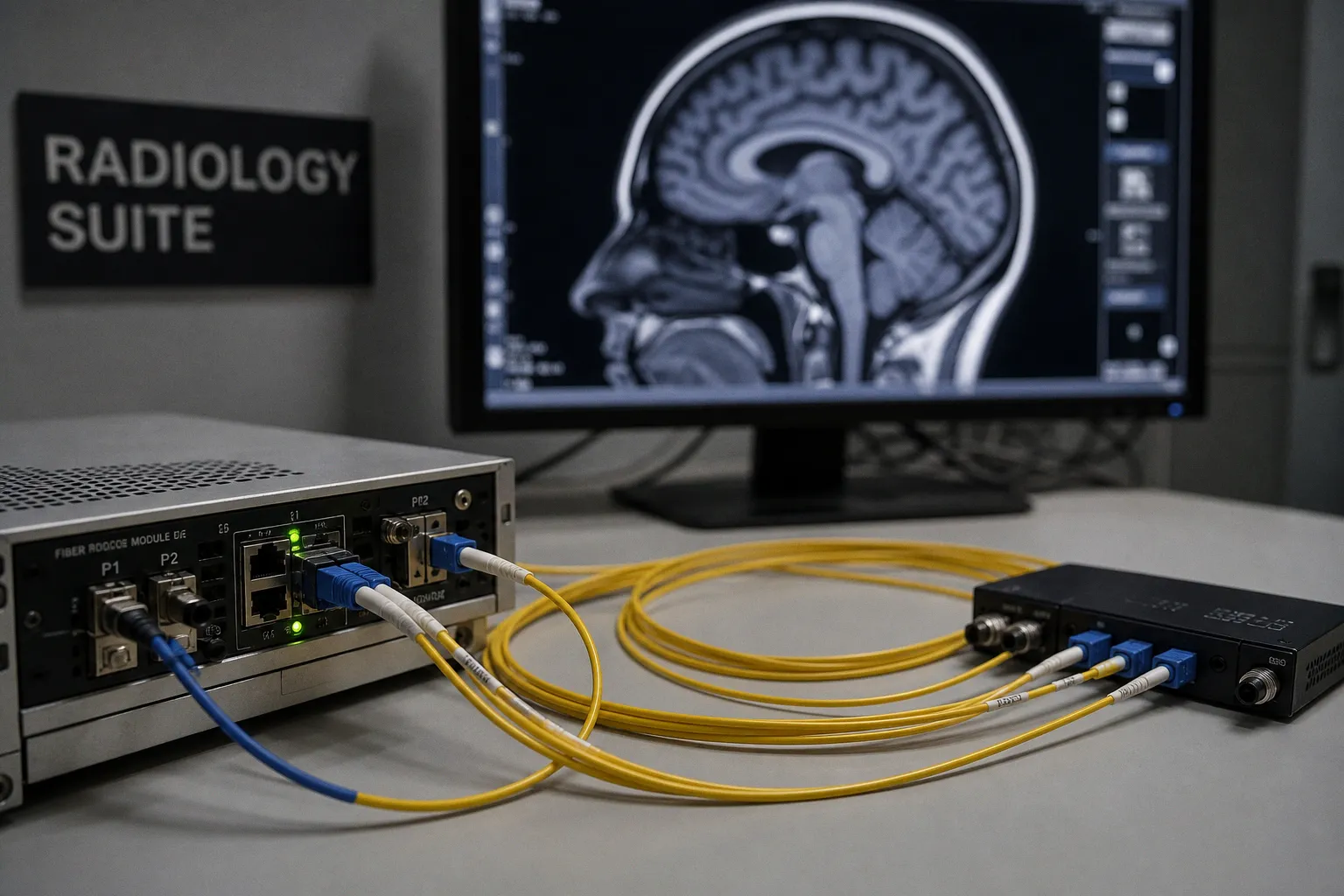
The distinction between C-MOVE and C-GET is not a matter of two interchangeable commands with slightly different names. It determines which device opens the connection, where the image data travels, how many network associations exist during retrieval, and whether a firewall or NAT boundary becomes a routine configuration problem or a major operational obstacle.
The practical dicom c-get vs c-move protocol difference begins with one question: after the query has identified the requested study, who is responsible for establishing the connection that carries the images?
With C-MOVE, the PACS or other Query/Retrieve Service Class Provider (SCP) creates a new outbound association to a destination Application Entity Title, or AET, and sends the images there using C-STORE. With C-GET, the images return through the same association that carried the retrieval request. The initiating client remains the only destination.
That architectural difference reaches far beyond packet flow. It shapes enterprise imaging design, cloud deployment, remote reading, data segmentation, and the amount of infrastructure required to make an MRI viewer function reliably across clinical boundaries.
The architectural divide: one retrieval request, two network models
C-MOVE and C-GET belong to the DICOM Composite Query/Retrieve Service Class and use DIMSE-C operations, alongside C-FIND and C-STORE. In a typical workflow, a client first sends a C-FIND request to locate a patient, study, series, or image instance. Once the relevant object has been identified, the client issues either C-MOVE or C-GET to retrieve it.
At the level of clinical intent, both commands appear to do the same thing: make the requested DICOM objects available to a workstation, archive, or application. At the level of networking, however, they produce two different topologies.
| Parameter | C-MOVE | C-GET |
|---|---|---|
| Image-transfer path | A separate C-STORE association from the PACS or SCP to the named destination | The existing association used by the requester |
| Number of associations | Two: the original C-MOVE request association and a separate inbound C-STORE association | One association for the request and image retrieval |
| Destination selection | Can send images to a third-party AET defined by the SCP | Can return images only to the client that initiated the request |
| Network prerequisites | Destination AET, IP address, and port generally need to be configured on the SCP | No separate inbound destination association is required |
| Firewall and NAT profile | More sensitive to inbound reachability and routing rules | Often simpler when the client can make an outbound connection |
| Common enterprise use | Routing studies to workstations, archives, or other DICOM nodes | Direct retrieval to the requesting application or viewer |
C-MOVE therefore behaves like a coordinated handoff. The requester asks the PACS to move the study to a specified destination, but the requester does not necessarily carry the image stream itself. The PACS uses the destination’s AET and network configuration to open another association and perform a sequence of C-STORE sub-operations.
C-GET is closer to a direct retrieval model. The client asks for the images, and the SCP sends the resulting C-STORE sub-operations across the active connection associated with that request. There is no second destination selected by the server, because the requestor is also the recipient.
The meaningful difference is not whether both commands retrieve MRI images; it is which system must be reachable when the retrieval becomes an actual transfer.
This is why a viewer can be perfectly capable of issuing C-MOVE and still be unsuitable for a segmented or cloud-based environment. The application may understand the DICOM command, while the surrounding network does not permit the association pattern that follows.
C-MOVE and the complexity of server-initiated associations
In a C-MOVE workflow, the client sends the request over its existing association to the PACS. The request identifies the destination AET and the level or set of objects to retrieve. The PACS then acts on that instruction by opening a separate C-STORE association to the destination.
The destination may be the same workstation that initiated the request, but it does not have to be. That is one of C-MOVE’s defining capabilities. A radiology workstation, a post-processing application, a second archive, or another enterprise imaging node can be named as the recipient, provided that the PACS has a valid configuration for it.
This makes C-MOVE highly useful in an institution where image routing is part of the workflow rather than merely a download operation. A central archive can receive a request from one system and transfer the study to another DICOM Application Entity. The requester acts as the initiator of the instruction, while the configured destination receives the data.
The arrangement also creates more points of failure. The PACS must know, and be able to reach, the destination’s:
- Application Entity Title;
- IP address or resolvable network endpoint;
- listening port;
- accepted presentation contexts and transfer syntaxes;
- network route and access permissions;
- association and security requirements.
If any of those elements is incorrect, the C-MOVE request may be accepted while the subsequent image transfer fails. A successful command-level exchange is not always proof that the study has arrived. Operationally, the system must distinguish between the status of the C-MOVE request and the result of the C-STORE sub-operations that carry the actual images.
This is particularly important in MRI environments where a single study may contain multiple series, derived images, localizer sequences, diffusion data, or large volumetric acquisitions. A transfer can be partially successful, delayed, or rejected at the object level even when the initiating request appears structurally valid. Monitoring must therefore follow the sub-operation results rather than stopping at the first positive response.
Why the AET matters
The AET is not simply a label displayed in a configuration screen. Within a C-MOVE workflow, it identifies the destination to which the SCP should send the images. In many PACS implementations, the AET is linked to a host and port in a server-side data table.
That design is manageable in a controlled hospital network. It becomes more demanding when the destination is a cloud-based MRI viewer, a remote reading workstation, or a service deployed across multiple security zones. The receiving endpoint may not have a stable address, may be hidden behind a NAT gateway, or may be intentionally prohibited from accepting inbound connections.
The PACS cannot solve that problem by knowing only the viewer’s user identity or web address. C-MOVE is operating in DICOM association terms: the server needs a reachable DICOM endpoint and a destination configuration that matches the association negotiation.
A further complication arises when several environments use similar AET conventions. Development, validation, production, disaster recovery, and regional imaging nodes may each require distinct routing entries. If those entries are copied without clear ownership and lifecycle management, the system becomes difficult to govern. A study may be sent to the wrong endpoint, or a formerly valid destination may remain enabled after a service has moved.
C-MOVE is not inherently inefficient
It is tempting to describe the two-association model as old-fashioned or automatically slower. That conclusion is not supported by the protocol distinction alone. Transfer latency depends on network routing, server hardware, storage performance, concurrency, compression, and the behavior of the receiving application. There is no universal speed result that makes C-MOVE inferior in every deployment.
C-MOVE can be operationally effective when the PACS is already designed as a routing hub and the destination nodes are stable, reachable, and well monitored. Its additional association is not an accidental burden in such an environment; it is the mechanism that gives the command its ability to direct images to a third-party destination.
The real cost is architectural complexity. More endpoints mean more configuration, more certificates or security rules where encryption is used, more logging, and more opportunities for a mismatch between what the clinical workflow expects and what the network permits.
C-GET: the single-connection retrieval model
C-GET uses the association created by the requesting client. The client sends the retrieval command, and the SCP returns the matching DICOM objects through that same TCP connection using C-STORE sub-operations.
The requester is therefore both the source of the command and the destination of the data. This is the central feature of the model, and it explains why C-GET can be attractive for a cloud-based MRI viewer or an application operating behind a tightly controlled firewall.
From a network perspective, the client does not need to expose a separate listening port for the PACS to initiate a new association. The connection already exists because the client opened it to make the request. A security boundary that permits outbound connectivity to the PACS may therefore be sufficient for the retrieval path, subject to the organization’s authentication, encryption, and DICOM implementation requirements.
The simplification is meaningful, but it should not be mistaken for a universal replacement for C-MOVE. C-GET does not tell the PACS to send images to an arbitrary third-party AET. It cannot function as a general routing instruction from one DICOM node to another. If the workflow requires a central archive to forward the study to a separate post-processing system, C-MOVE or another routing mechanism is the more natural fit.
The C-GET model is best understood as direct retrieval for the application that asked for the data. This may suit:
- a diagnostic viewer retrieving a study for immediate interpretation;
- a research application requesting a defined series for analysis;
- a service that must operate across a restrictive network boundary;
- a controlled workflow in which the initiating client is also the final consumer.
It can also reduce the number of DICOM endpoint relationships that need to be maintained. Instead of registering every temporary or distributed viewer as a destination to which the PACS may initiate a connection, the environment can concentrate on the requester’s outbound association and the server’s ability to respond over it.
The misconception about C-GET
C-GET is sometimes described as retired, obsolete, or removed from the DICOM standard. That is incorrect. C-GET remains defined and available within the standard.
The more accurate statement is that C-MOVE is more commonly encountered in many conventional PACS deployments, particularly where routing to multiple configured DICOM destinations is central to the institution’s workflow. Familiarity and implementation history should not be confused with deprecation.
This distinction matters when an organization evaluates an MRI viewer or integration engine. A product may support C-MOVE broadly and C-GET narrowly, or it may support both but expose different controls for association negotiation, transfer syntax handling, cancellation, and failure reporting. The question is not whether one command is modern and the other outdated. The question is whether the command’s network behavior matches the deployment’s clinical and security requirements.
Firewalls, NAT, and the geography of the clinical network
The contrast between C-MOVE and C-GET becomes most visible when imaging systems are separated by firewalls, private subnets, VPNs, or NAT.
With C-MOVE, the PACS initiates the C-STORE association toward the named destination. For that to work, the destination must be reachable from the PACS network. If the workstation or application is behind NAT, the PACS may be unable to address it directly, or the apparent IP address may not correspond to a routable endpoint. Firewall rules may need to allow inbound traffic to the receiving port, and those rules may need to remain stable as endpoints change.
C-GET avoids the separate inbound association because the initiating client opens the connection first. The image data travels back across that established connection. This often aligns more naturally with modern network policies, which commonly permit controlled outbound connections while restricting unsolicited inbound traffic.
Still, C-GET is not a security feature by itself. It does not automatically provide encryption, identity assurance, authorization, or auditability. Those properties depend on the implementation and the surrounding architecture. DICOM communication may be protected through appropriate transport security, but the exact capabilities and configuration need to be established for the products involved. A single association can be simpler to route while remaining inadequately secured if authentication and transport controls are poorly designed.
Consider the implications for a cloud deployment. A cloud viewer may appear to favor C-GET because it can initiate a connection to an enterprise PACS without requiring the PACS to reach into the cloud environment. But a clinical service still needs a governed integration boundary, clear data ownership, reliable failure recovery, and a method of controlling which studies the application may retrieve. Network simplicity does not remove the need for clinical authorization.
A practical comparison of deployment conditions
| Deployment condition | More natural fit | Reason |
|---|---|---|
| Stable hospital network with registered DICOM destinations | C-MOVE | The PACS can reach configured AETs and route studies to multiple systems |
| Viewer behind strict inbound firewall rules | C-GET | The requester can use one established connection for both request and retrieval |
| PACS routing to a third-party archive | C-MOVE | C-MOVE can direct the transfer to a destination different from the requester |
| Research client retrieving data for its own analysis session | C-GET | The requesting application is also the intended recipient |
| Large multi-site network with changing endpoints | Depends on gateway design | A routing broker or integration layer may be needed regardless of command |
| Direct transfer to a temporary or user-specific destination | Often C-GET | Avoids registering every transient client as a server-side C-MOVE destination |
The table is not a product-selection rule. It is a way to expose the underlying topology before an organization becomes distracted by viewer features. A technically elegant application can still fail if its preferred retrieval command does not match the direction of permitted network traffic.
Third-party routing and the limits of direct retrieval
The most important functional difference between the commands is the destination model.
C-MOVE allows the requester to identify a third-party destination AET. The PACS then performs the transfer to that destination through a separate C-STORE association. This makes C-MOVE suitable for workflows in which the initiating system is not the final recipient.
For example, a clinical application might locate a study in an archive while asking the archive to send it to a dedicated segmentation server. The segmentation server is not the application that issued the query, but it can still receive the images if it is configured as a valid destination and is reachable from the PACS.
C-GET does not offer that indirection. Its images return exclusively to the client that initiated the request. If another system needs the same data, it must retrieve the data itself or receive it through a separate application-level process. Treating C-GET as a hidden routing command leads to an architectural mismatch that is often discovered only during integration testing.
This distinction also affects de-identification workflows. A research service may use C-GET to retrieve source images directly into its controlled processing environment, where de-identification and study governance occur before analysis. A C-MOVE-based workflow may instead route images to a designated de-identification gateway. Neither pattern is inherently more compliant. The correct choice depends on where identity transformation occurs, which system is authorized to access identifiable data, and how the transfer is audited.
DICOM retrieval also exists within a broader enterprise ecosystem. HL7 and FHIR may carry orders, demographics, clinical context, or workflow events, but they do not replace the DICOM Query/Retrieve operations used to move the image objects themselves. A robust integration design must connect these layers without confusing their roles.
An order event may arrive through an information system, a study may be stored in PACS, and a viewer may use DICOM to retrieve the images. The workflow is clinically unified, but the protocols remain distinct. The handoff between them must preserve patient identity, accession context, study identifiers, and authorization boundaries over time.
What this means for MRI software engineering
MRI data is not a single uniform payload. A study may include many series, varying acquisition parameters, derived maps, and objects whose clinical value depends on their relationship to the original examination. Integration software must therefore handle more than successful socket establishment.
A production-grade implementation should make the following behavior visible and testable:
- whether the client supports the required Query/Retrieve information models;
- how it negotiates presentation contexts and transfer syntaxes;
- whether it reports individual C-STORE sub-operation failures;
- how it handles partial retrieval and cancellation;
- whether duplicate objects are detected or silently reprocessed;
- how association timeouts and interrupted transfers are recovered;
- how audit records connect the retrieval request to the received study;
- how de-identification is applied when research data leaves the clinical domain.
With C-MOVE, monitoring should include the second association and the destination-side receipt. The PACS may accept the request while the receiving node rejects an object because of an unsupported transfer syntax, incorrect calling or called AE title, or a policy failure. With C-GET, monitoring should follow the single association through both command execution and object delivery, while still distinguishing a completed request from a complete and clinically usable study.
The choice also has consequences for capacity planning. C-MOVE can produce simultaneous associations from a PACS to multiple destinations, especially when several users or downstream systems request studies concurrently. C-GET concentrates the transfer within the requester’s session, but it can still create substantial load on the archive, the application, and the network. Neither command eliminates the need to understand storage throughput, concurrency limits, and the behavior of large MRI series.
A simpler association model reduces one class of failure; it does not reduce the biological complexity of the data or the clinical responsibility attached to it.
For enterprise imaging teams, the most valuable design exercise is often a topology review rather than a command preference debate. Map the requester, the archive, the possible destination, the firewall boundary, and the point at which data is de-identified or transformed. Then ask whether the transfer command expresses that map honestly.
If the image must reach a system other than the requester, C-MOVE’s third-party destination model is fundamental. If the requester is also the recipient and inbound connectivity is constrained, C-GET may be a more coherent fit. If both patterns are needed, supporting both can be reasonable, provided that the user interface, monitoring, and security model make the difference explicit.
Choosing between C-MOVE and C-GET without oversimplifying the decision
The strongest implementations treat C-MOVE and C-GET as workflow primitives, not as competing brands of the same feature.
C-MOVE is usually the more expressive option when the PACS is expected to act as a routing authority. It can send data to a configured destination independent of the system that initiated the request, which supports established enterprise patterns involving archives, workstations, analytics platforms, and specialty processing nodes. Its cost is the additional network association and the operational work required to maintain reachable destinations.
C-GET is often the cleaner option when a client needs to retrieve data for itself across a controlled network boundary. Reusing the active association can avoid the inbound connectivity requirements that complicate C-MOVE behind firewalls and NAT. Its limitation is equally clear: it cannot redirect the retrieved objects to a third-party AET.
A careful evaluation should therefore begin with the questions that expose the clinical workflow:
1. Is the requester also the final recipient of the MRI objects?
2. Does the PACS need to route the study to another DICOM node?
3. Which side of the network boundary is permitted to initiate connections?
4. Are destination AETs stable enough to maintain in server-side configuration?
5. How will partial transfers and failed C-STORE sub-operations be surfaced?
6. Where will de-identification, secondary processing, and audit capture occur?
7. Does the deployment include cloud or remote endpoints whose addressability changes over time?
The answers may lead to different choices for different paths within the same institution. A diagnostic viewer might use C-GET for direct retrieval, while an archive-to-segmentation workflow uses C-MOVE. Standardization is valuable, but forcing every workflow into a single command can create unnecessary fragility.
The clinical meaning of a network decision
DICOM association behavior can sound remote from patient care, yet the consequences appear at the clinical endpoint. A failed route can delay access to a prior MRI. A partial retrieval can omit a series needed for comparison. An undocumented destination can send data into the wrong processing environment. A firewall exception that works for one workstation may become a persistent security liability when multiplied across an enterprise.
The protocol does not determine the quality of the diagnosis, and neither C-GET nor C-MOVE is a biomarker or a clinical intervention. What they determine is whether the right image objects can move through the system in a traceable, recoverable, and authorized way.
The dicom c-get vs c-move protocol difference is therefore best understood as a difference in responsibility. C-MOVE asks the PACS to establish a new transfer relationship with a named destination. C-GET keeps the retrieval relationship with the requesting client and uses that same connection to return the data. Once that distinction is clear, the decisions about firewall policy, cloud architecture, PACS configuration, and workflow integration become much less mysterious.
A mature MRI platform does not choose the command that sounds simpler in isolation. It chooses the association model that matches the clinical path of the data, then builds monitoring and governance around the places where that path can fail. That is the quiet engineering work behind a viewer that feels instantaneous to the radiologist and dependable across the longitudinal record.