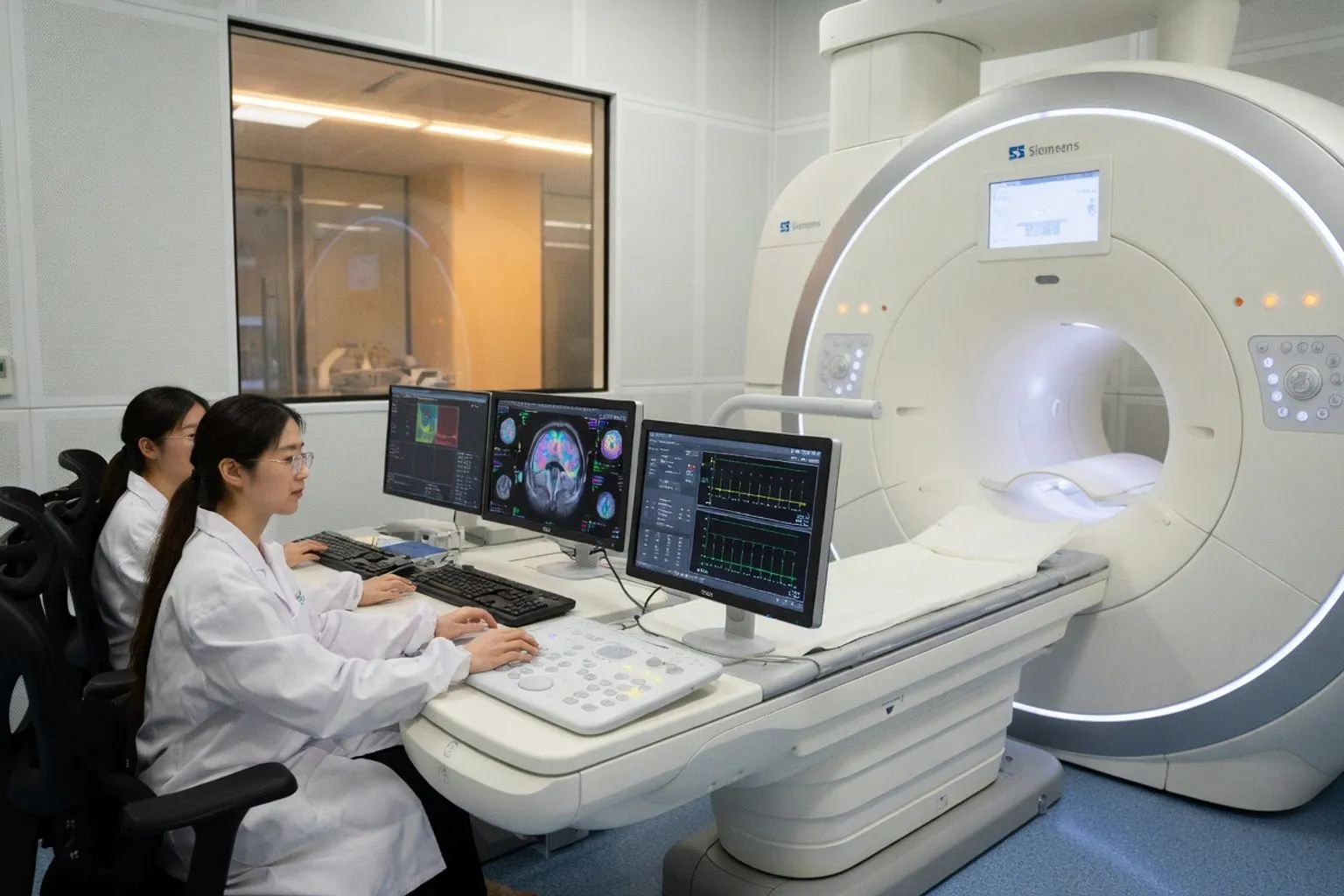
According to Global Times, China has announced what the outlet describes as the world's first full-stack MRI-based brain-computer interface (BCI) solution — a system positioned to make neural plasticity, in the report's framing, measurable and controllable through an integrated imaging-and-decoding workflow. For readers working at the intersection of MRI software and clinical neuroscience, the announcement matters less for the headline adjectives than for the architectural claim behind them: that acquisition, reconstruction, and BCI signal processing can now sit inside a single pipeline rather than being stitched together from independent tools.
What was actually announced
The coverage, carried by Global Times this week, frames the release as a "full-stack" platform in which MRI acquisition, image processing, and BCI decoding are bundled into one workflow. The published English-language snippet does not detail which imaging sequences, field strength, or reconstruction algorithms anchor the system, nor does it name the originating research group with confidence. The surrounding page context mentions BCI clinical work in Bengbu and a research team from Northwestern Polytechnical University in Xi'an, but the connection between those fragments and the headline MRI-BCI release is not made explicit in the text available to us.
That gap is worth naming. A "full-stack" claim in this domain is not a marketing flourish — it implies shared calibration, synchronized timing between MR volumes and neural acquisition, and a reconstruction layer that knows what the decoder downstream expects. Consider the implications: if the validation was performed only on the developers' own scanner with their own reconstruction parameters, the portability of the plasticity readout across institutions remains an open question.
Why an MRI-coupled BCI matters here
For radiologists and MR physicists, the practical question is not whether plasticity happens — it does, in many forms — but whether a given imaging pipeline can reliably detect it against session-to-session variance, head motion, and physiological fluctuation. BCI systems add a second layer of difficulty: the need to co-register electrophysiological or hemodynamic signals against structural and functional MRI frames with the kind of accuracy a clinician would trust.
This shift allows us to rethink BCI training as a longitudinal imaging study, where each therapy session becomes a timepoint in a trajectory plotted against a baseline atlas. The Bengbu rehabilitation program visible in the surrounding coverage — where BCI devices are already being used for hand therapy in a hospital setting — points to where such an integrated stack would be deployed first. Neurorehabilitation is the natural proving ground: the clinical endpoints (motor recovery scores, functional independence measures) are established, and the expected plasticity signal is large enough to be detectable at clinically relevant field strengths.
What to watch
Three questions will frame how seriously this announcement should be taken once the technical details emerge. First, what MRI contrasts carry the plasticity readout — structural morphometry, diffusion-derived tract changes, functional connectivity shifts, or a composite score? Second, how is the BCI signal synchronized with the imaging volume, and what does the co-registration pipeline look like at 3T versus 7T? Third, and most important for translation, are the reported plasticity changes correlated with patient-centered outcomes, or only with internal decoding accuracy?
These are the kinds of details our audience is positioned to evaluate — not the adjectives in the press release. We will revisit the story once peer-reviewed methods and independent validation cohorts become available.