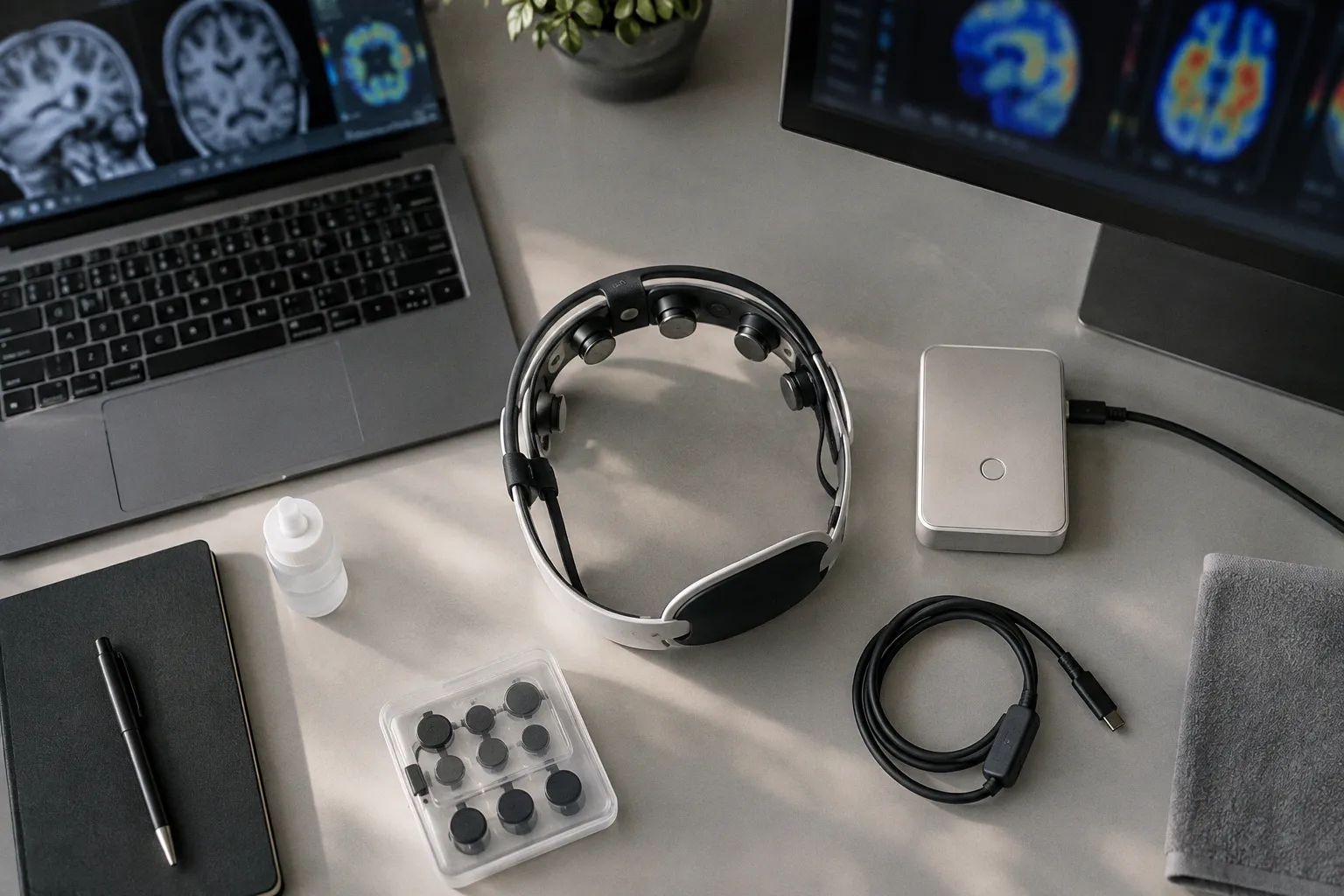
A Shift in How We Might Listen to the Brain
There is a persistent challenge in non-invasive neural sensing that has long defined the boundaries of what clinicians and researchers can practically achieve outside the scanner room: the skull itself acts as a formidable filter, attenuating the electrical signals we try to capture from the scalp's surface and leaving us with measurements that, however useful, offer only a blurred portrait of the brain's true activity. Consider, then, the implications of Apple's quiet acquisition of Sonera, a small California startup that has spent nearly a decade pursuing an alternative physics — magnetic rather than electrical detection — in the hope of making neural and neuromuscular monitoring portable, wearable, and far less compromised by the body's own architecture.
What Sonera Built, and Why It Matters
Sonera, founded in 2018 by Nishita Deka and Dominic Labanowski while they were students at UC Berkeley, emerged from stealth in 2023 after raising eleven million dollars to develop room-temperature magnetometers based on acoustically-driven ferromagnetic resonance. The approach is notable for what it eliminates: rather than requiring the superconducting coils and cryogenic cooling of magnetoencephalography systems — equipment confined to shielded rooms and specialist facilities — Sonera's sensors are designed to detect the weak magnetic fields generated by neural and muscular activity using chips small enough to integrate into consumer devices. Their first product, the S1 chip, was oriented toward muscle sensing, with applications ranging from prosthetic control to wearable health monitoring. The leap from muscle to brain is not trivial, but the underlying magnetic physics is the same; what differs is the signal strength and the processing required to extract meaningful patterns from far noisier data.
A Deal Sealed Months Before the News Broke
European Union acquisition records indicate that Apple completed its purchase of Sonera in May 2026, though neither company has issued a public announcement and Sonera's website has since gone offline. For those of us who track the translational pipeline from sensor engineering to clinical utility, the timing and the silence are both instructive. Apple has already demonstrated interest in brain-computer interfaces through features like Switch Control and through demonstrations of Apple Vision Pro paired with implanted neural systems; acquiring a company working on non-invasive magnetic sensors suggests a longer-term strategy to move beyond electrical paradigms toward something potentially more faithful to the brain's actual output — without the surgical burden of implantation.
What This Means for the Neuroimaging Community
This shift allows us to envision a future trajectory where high-fidelity neural data is no longer gated behind institutional infrastructure, where longitudinal monitoring of neuromuscular conditions might happen through a wearable rather than a quarterly clinic visit, and where the subtle degradation patterns we currently detect only in controlled research settings could, in principle, be tracked in daily life. Yet it is worth tempering enthusiasm with the clinical realism we have earned through decades of biomarker hype cycles: a promising sensing modality in a startup lab is not the same as a validated diagnostic tool, and the path from a muscle-sensing chip to reliable, artifact-free brain monitoring in a consumer watch is long, nonlinear, and full of signal-processing challenges that no acquisition can shortcut. What Apple has acquired is not a cure or a breakthrough, but a foundation — and for the neuroimaging research community, the most important question now is whether the company will open that foundation to the broader scientific ecosystem or keep it locked inside a proprietary product pipeline.