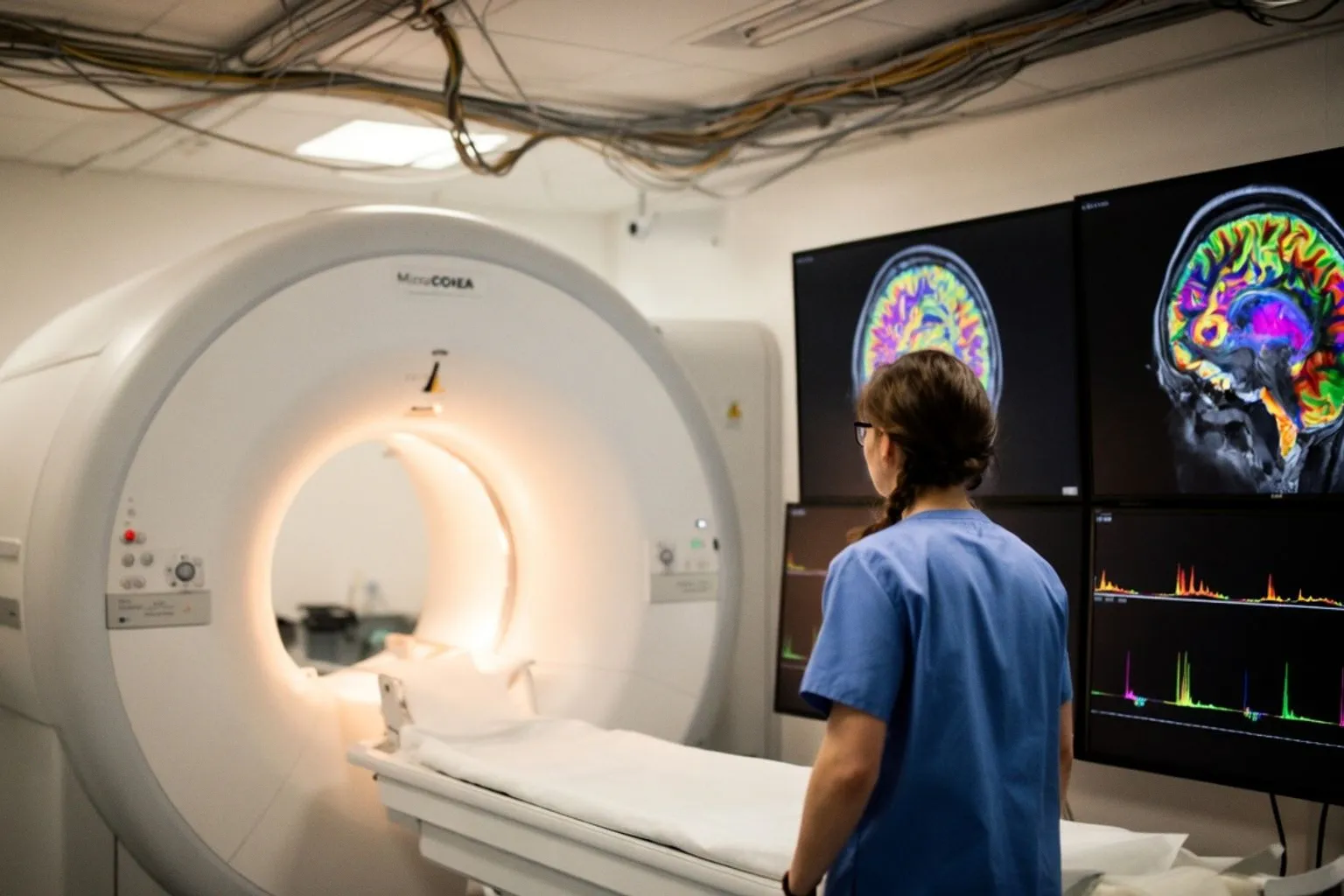
According to coverage on finance.biggo.com, Tianjin University and United Imaging Healthcare jointly unveiled the uMR NeuroView on August 23 — a full-stack MRI-based BCI solution that compresses years of research-grade methodology into a deployable clinical toolkit. The release landed just two days before China's Ministry of Industry and Information Technology opened public comment on its National BCI Industry Standards System Construction Guidelines (2026 Edition), which set a target of more than forty standards by 2028 and over eighty by 2030 across seven domains. For neuroimaging software developers and translational researchers, the timing is not coincidental: MRI is being reframed as the spatial-temporal scaffold on which neuromodulation, decoding, and feedback loops will hang.
The system emerges from a year of joint work on magnetic compatibility, MRI adaptation for BCI working environments, software and data fusion, and the notoriously delicate migration from animal studies to human clinical scenarios. The team's plan is to further adapt the package to select 3T and 5T systems within United Imaging's installed base, and this matters because field strength is not merely a marketing detail. Consider what happens when a subject lies inside the scanner wearing signal acquisition devices and performs interactive tasks while brain activity is simultaneously recorded — the hemodynamic lag that Fan Qiuyun, Associate Dean of Tianjin University's School of Medicine, notes can stretch several seconds behind actual neural events. That gap means any closed-loop claim must be examined carefully: functional MRI captures blood-oxygen level changes rather than the action potentials themselves, and the difference between these two timescales is precisely where many BCI architectures falter in translation.
From Structural Target to Real-Time Navigation
Yuan Jianmin, Director of United Imaging's MRI Business Unit and Joint Innovation Department, framed the scanner's role in the BCI workflow by likening it to BeiDou navigation — structural imaging identifies the target region, then provides continuous positional guidance during subsequent stimulation or neuromodulation therapies. The analogy earns its weight in the case of non-invasive BCI combined with focused ultrasound, where researchers must know exactly where the target sits before external energy can be directed accurately. The workflow does not stop at localization, however. Focused ultrasound produces localized temperature elevation during treatment, and MRI can monitor that temperature in real time to confirm the therapeutic window remains intact — warm enough to act on tissue, cool enough to spare it. The platform claims simultaneous capture of neural activity at millisecond precision alongside structural measurement at sub-millimeter resolution, which is the combination that has historically eluded single-modality BCI systems.
What a Unified Stack Means for Clinical Translation
For radiologists and medical software developers, the practical implication is integration depth. Rather than bolting a standalone BCI device onto a conventional scanner, the uMR NeuroView aims to keep decoding, modulation, and effect measurement within one framework — a true closed loop rather than a series of loosely coupled instruments. The research team noted that this architecture can track rapidly changing signals and localize where those signals originate at the same time, addressing the temporal-spatial trade-off that has long constrained BCI imaging studies. Whether that integration survives regulatory scrutiny in markets outside China remains an open question, and the 2026 standards effort will be worth watching as it crystallizes definitions around data formats, device safety, and the interoperability boundaries between imaging and neural interface hardware.