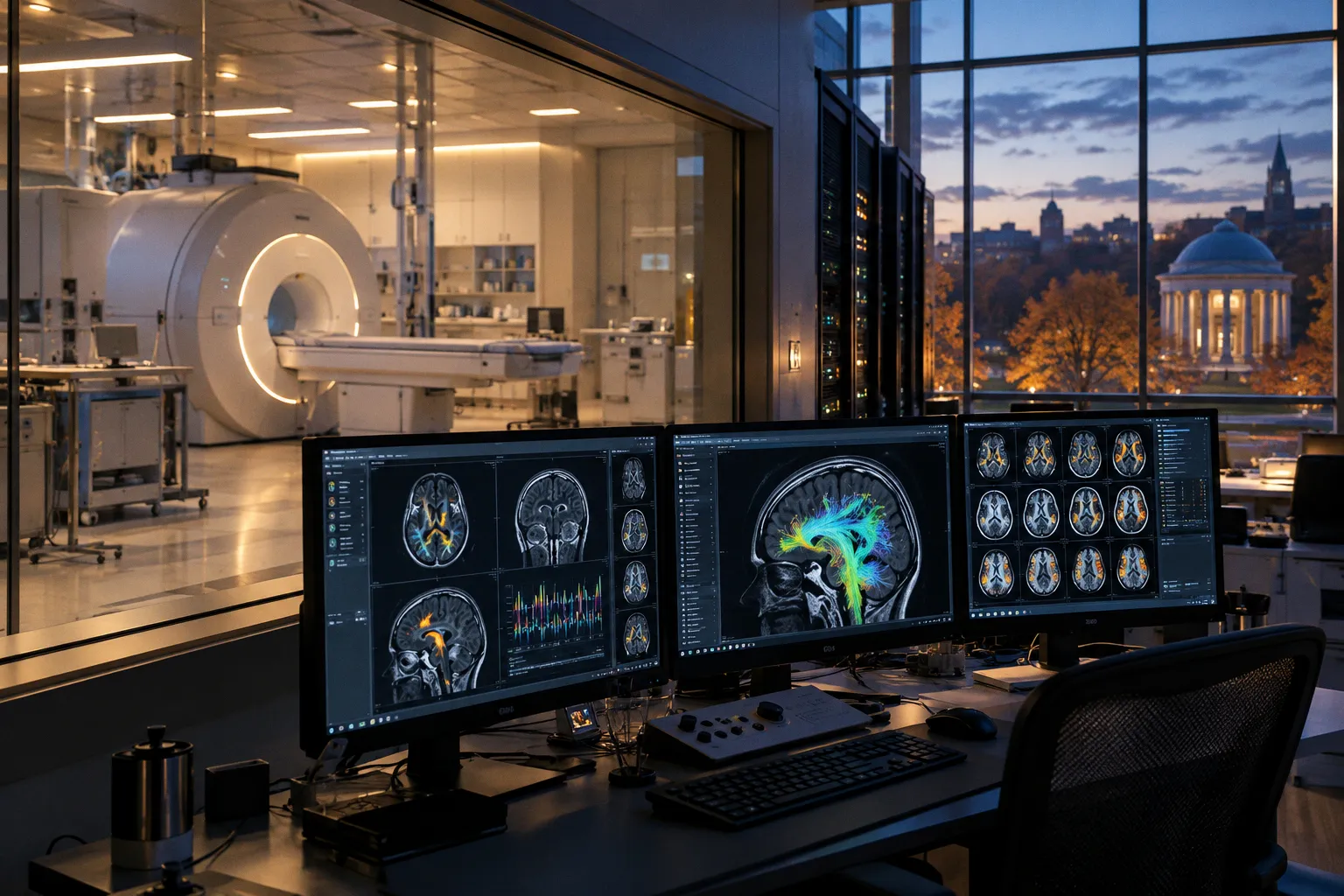
A team at the University of North Carolina at Chapel Hill has introduced a functional MRI acquisition strategy called SORDINO that, as Medical Xpress reports, could make whole-brain activity mapping in awake, behaving animals substantially more faithful to the underlying neural events. The approach, described in Nature Neuroscience, trades the abrupt gradient switching of conventional sequences for continuously rotating directions—an architectural shift that should matter wherever motion, acoustic noise, and field inhomogeneity have long threatened the BOLD signal.
A smoother trajectory through k-space
Senior author Yen-Yu Ian Shih frames the problem with clinical candor: conventional EPI and zero-echo-time MRI methods produce moments when magnetic field gradients change rapidly, followed by long stretches of relative stasis, and it is that uneven tempo that makes the sequences loud, artifact-prone, and difficult to deploy on awake subjects. SORDINO spreads those gradient changes smoothly over time, keeping overall gradient strength nearly constant while direction rotates. Shih's preferred metaphor—conventional ZTE behaving like a ticking second hand snapping between positions, SORDINO like a modern second hand gliding continuously around the dial—captures both the engineering choice and the practical promise: fewer abrupt transients, fewer opportunities for the scanner to contaminate a fragile behavioral paradigm. This shift allows the approach to collect signal continuously during the gradual direction changes, potentially shortening the time required to establish functional contrast and thereby expanding the window available for actual recording.
What changes downstream
The demonstration sits firmly in preclinical territory—head-fixed awake rodents during behavioral tasks and social interactions—which positions SORDINO as a tool for circuit dissection rather than immediate human application. For groups running behavioral paradigms in awake animals, the gain is tangible: time saved on contrast preparation compounds across cohorts, and any reduction in motion-corrupted volumes directly improves the reliability of downstream connectivity estimates. Several adjacent developments reported this week—a brain-mapping tool aimed at refining deep brain stimulation surgery for Parkinson's, a brain-computer interface that reportedly restored real-time speech for an ALS patient, and China's first AI-driven data standard for brain-computer interface medical devices—underline how tightly upstream signal quality now binds to downstream clinical or regulatory claims.
What to watch before prototyping
Three checkpoints seem prudent. The published evidence rests on preclinical rodent data, and translation to human protocols has not yet been demonstrated. The gain in motion robustness should be measured against any cost in temporal resolution or sensitivity per unit time, since smooth gradients exchange one set of physics tradeoffs for another. And for groups integrating SORDINO outputs into pipelines—motion correction, GLM fitting, atlas-based parcellation—the preprocessing stack will need to be revalidated rather than simply retuned, and existing toolchains, most of which assume discrete k-space shots, will require explicit support for a continuously varying trajectory. The biology is moving forward; the engineering has homework to do.