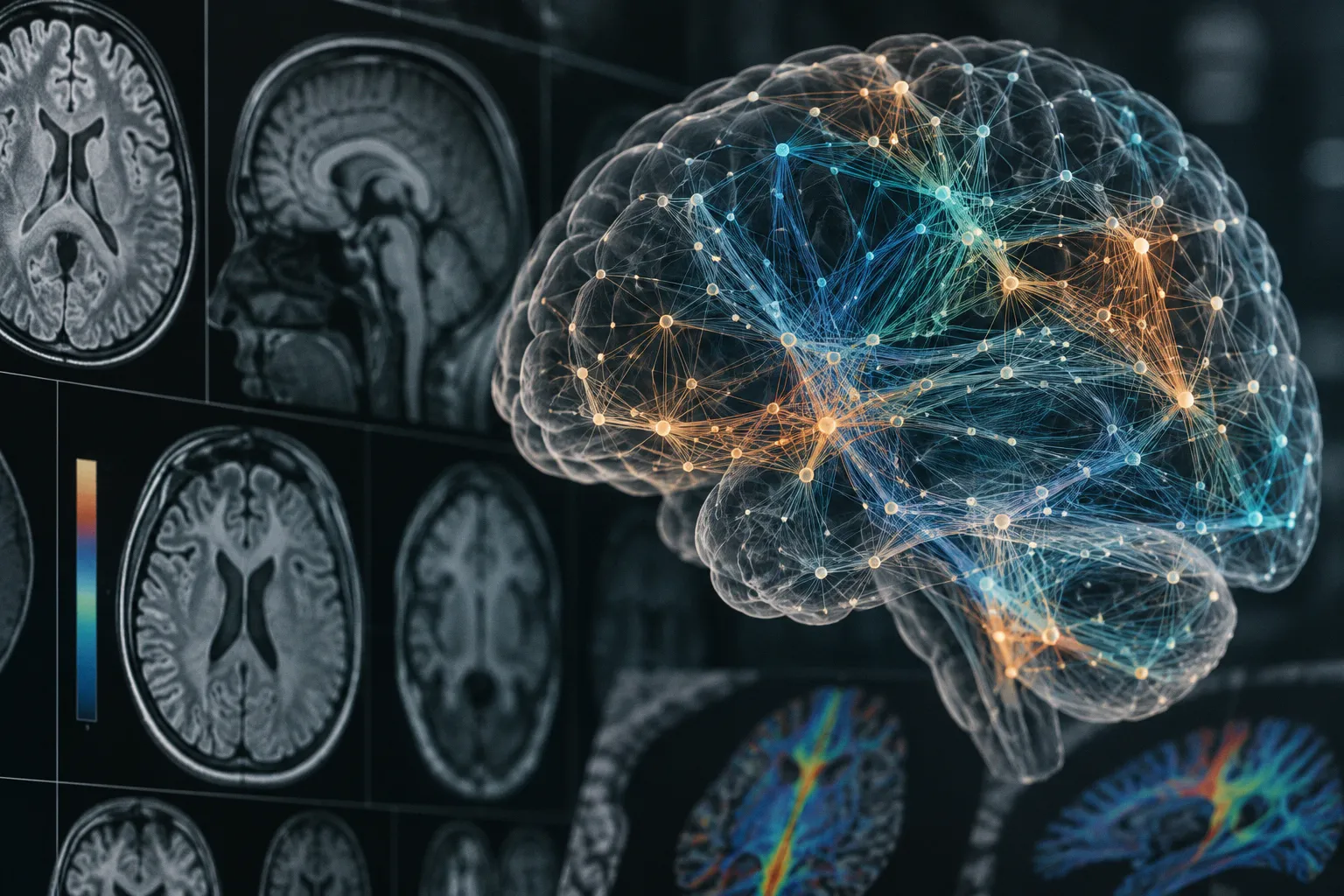
That mismatch between the average atlas and the individual patient sits at the heart of a fresh round of funding for Xijia Medical, an AI brain-science company that, according to 36Kr, has just closed a Pre-Series A round of tens of millions of yuan led by Sinocapital, with Xi Venture Capital, Qinzhi Capital, Huichuang Medical and Xingfu Capital joining the syndicate. The proceeds are earmarked for clinical research, market expansion and product iteration — a trajectory worth following for anyone working at the intersection of MRI software and surgical decision-making.
From the HCP average to the individual cortex
The clinical problem Xijia Medical has organized itself around is one clinicians recognize immediately. The widely cited Human Connectome Project atlas, published in 2016 by Matthew F. Glasser and colleagues, divides the cerebral cortex into 360 regions and has become a foundational reference for research and for many diagnostic workflows. Yet, as the company's CFO Quan Yuan has noted, human head sizes, sulci and gyri all differ; tumors and edema can compress surrounding tissue and displace entire regions. An average atlas, however beautifully resolved, cannot be transposed onto a specific brain without introducing error at exactly the moment precision matters most.
Xijia Medical's response, built since its 2019 founding, has been to train machine-learning algorithms on large volumes of MRI data and combine connectomics with cloud infrastructure to produce individualized brain network maps. Its core software, NuraTome, contains an atlas framework of 379 regions — 360 cortical parcels drawn from the HCP work, supplemented with 19 additional subcortical regions. The company's team began developing these AI capabilities in 2017, well before large language models reshaped the broader AI landscape, and the focus has remained on MRI-derived structural and functional data rather than on language or vision tasks.
Where the maps are actually used
For readers who build or validate neuroimaging tools, the interesting question is where these individualized maps are being deployed today. According to 36Kr, the current clinical applications cluster around three workflows: neurosurgical planning, transcranial magnetic stimulation (TMS) navigation, and pre-implantation positioning of electrodes for brain-computer interfaces. The company has built TMS navigation equipment that runs on top of NuraTome, and early clinical experience suggests that patients receiving TMS treatment for depression show a meaningful improvement in symptom reduction relative to their baseline, with a reportedly favorable clinical remission rate — though the underlying data have not yet been published in a peer-reviewed venue.
On the BCI side, Xijia Medical reports that its infrastructure has cumulatively supported more than 20 clinical electrode implantations, positioning the software as an upstream navigation layer for BCI developers rather than as an implant manufacturer itself. This positioning matters because it sidesteps the most invasive regulatory territory and instead plays to the company's strength in atlas-to-patient registration.
A regulatory tailwind worth tracking
The timing of this round coincides with a regulatory development that clinicians and BCI developers should not overlook. As reported by Xinhua, China's National Medical Products Administration has approved and issued the country's third medical-device standard for brain-computer interfaces — and the world's first such standard specifically governing AI algorithms that post-process EEG signals in BCI medical devices. The standard specifies quality requirements and evaluation methods for the EEG datasets used in research, production and quality control, covering collection, processing, annotation, storage and access. Two earlier Chinese BCI standards, issued in 2025, addressed terminology and test methods for implantable neural stimulators with closed-loop functions.
This shift allows us to see a coherent policy environment taking shape around EEG data quality, which is precisely the substrate that AI-powered BCI decoding depends upon. For developers building downstream applications — speech decoding, motor restoration, hybrid speech-and-movement interfaces such as those being explored in early U.S. work — the Chinese emphasis on dataset integrity is a reminder that algorithmic performance is only as trustworthy as the signals feeding it.
What to watch next
For the neuroimaging community, several trajectories are worth monitoring as Xijia Medical deploys this new capital. First, whether the clinical remission data for TMS-guided depression treatment move from company disclosures into peer-reviewed publication, where the methodology — target selection, stimulation parameters, longitudinal follow-up — can be scrutinized. Second, whether the 379-region atlas framework, with its hybrid cortical-subcortical scope, gains adoption beyond the company's internal workflows and becomes a shared resource for the broader research community. And third, how the emerging Chinese BCI standards interact with international regulatory frameworks, particularly as BCI trials increasingly span borders. The map is getting more personal; the question now is how the field will validate what that personalization is actually worth.