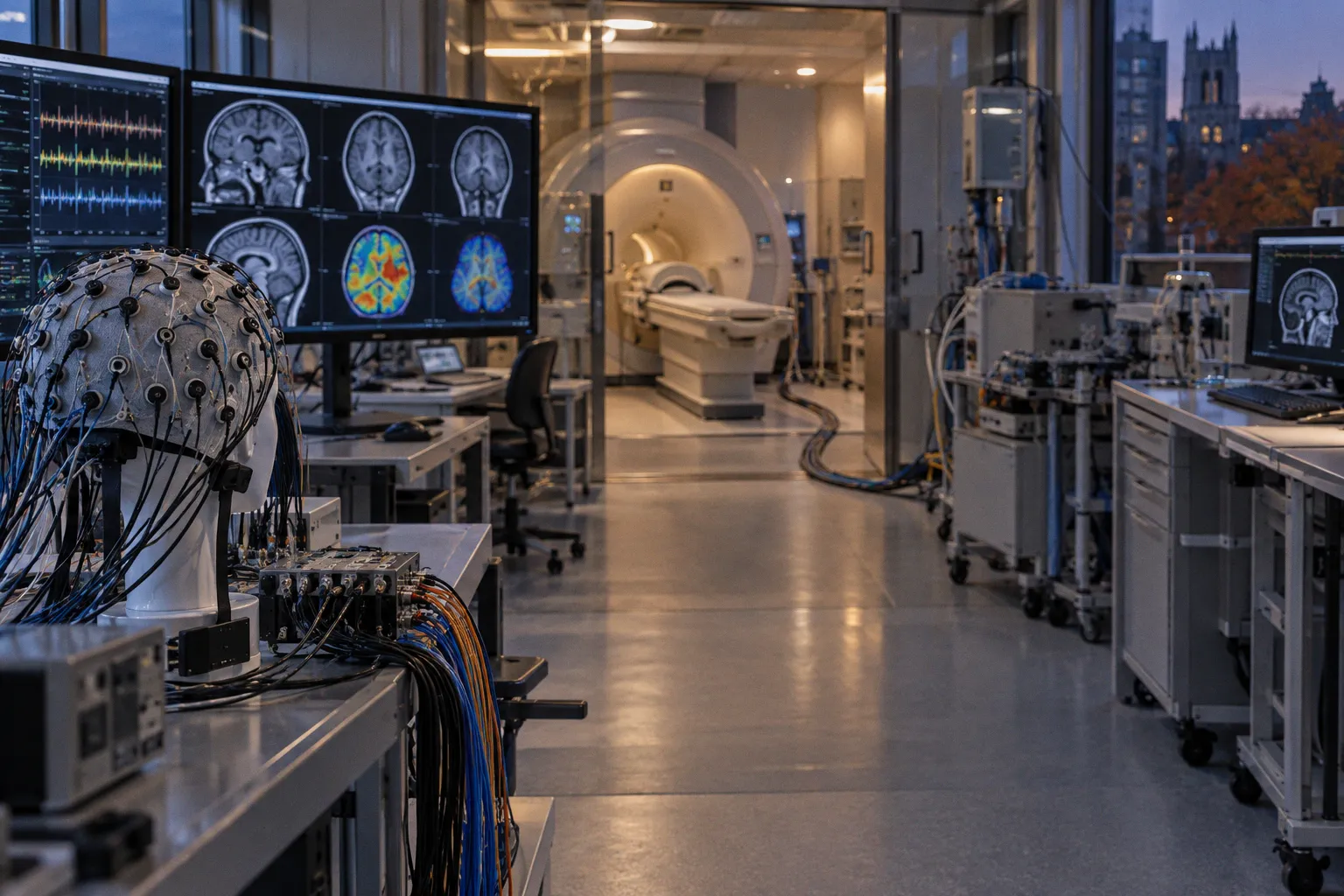
For decades, the clinical challenge of restoring communication in patients with severe paralysis has outpaced the engineering solutions available to address it; eye-tracking text-to-speech remains the standard of care, but it is slow, physically exhausting, and strips conversation of nearly every nonverbal cue. A new study from the University of California, San Francisco, reported in Nature Neuroscience, suggests that brain-computer interfaces are beginning to close that gap in a meaningful way.
A bidirectional motor cortex decoder
Working with three participants living with vocal tract and bodily paralysis, the UCSF team led by Dr. Edward Chang placed thin strips of sensors called electrocorticography (ECoG) arrays directly onto the motor cortex. Machine learning decoders then translated the resulting neural activity into commands that drove a full-body virtual avatar. Two of the three participants were able to convey both speech and upper-body gestures simultaneously through the avatar, a first for implanted BCI systems. Chang framed the work in motor-cortex terms rather than speech terms: conversation, he noted, is "a multilayered, dynamic process involving the whole motor cortex," and the proof-of-concept shows it is possible for a BCI to restore some of this freedom and flexibility.
The "more than the sum" problem
The most clinically interesting finding is methodological. Earlier models assumed that simultaneous speech-and-gesture signals would simply combine the patterns seen when each mode is used alone. The data tell a different story: overlapping but distinctly shaped signatures emerge only when both modes are attempted together, so decoders trained on this concurrent training set performed better at deciphering mixed expressions than those trained on isolated speech or gesture data alone. For anyone building real-world neuroimaging pipelines, the implication is that training corpora must reflect the natural co-articulation of behavior rather than its artificial isolation, a subtle but consequential shift in how we think about decoding models that extend well beyond the avatar itself.
What to watch next
The hardware and decoding pipeline remain invasive, and the participant cohort is small, so longitudinal performance in outpatient settings is the next pressure test. In parallel, regulatory architectures are being negotiated elsewhere; separate reporting points to what is described as the world's first national standard for AI-enabled brain-computer interface medical devices, a step that may shape how multimodal decoders like the UCSF system are evaluated for clinical approval across markets. Until those standards converge, the most honest position is that proof-of-concept has arrived, and the engineering work of scaling it is just beginning.