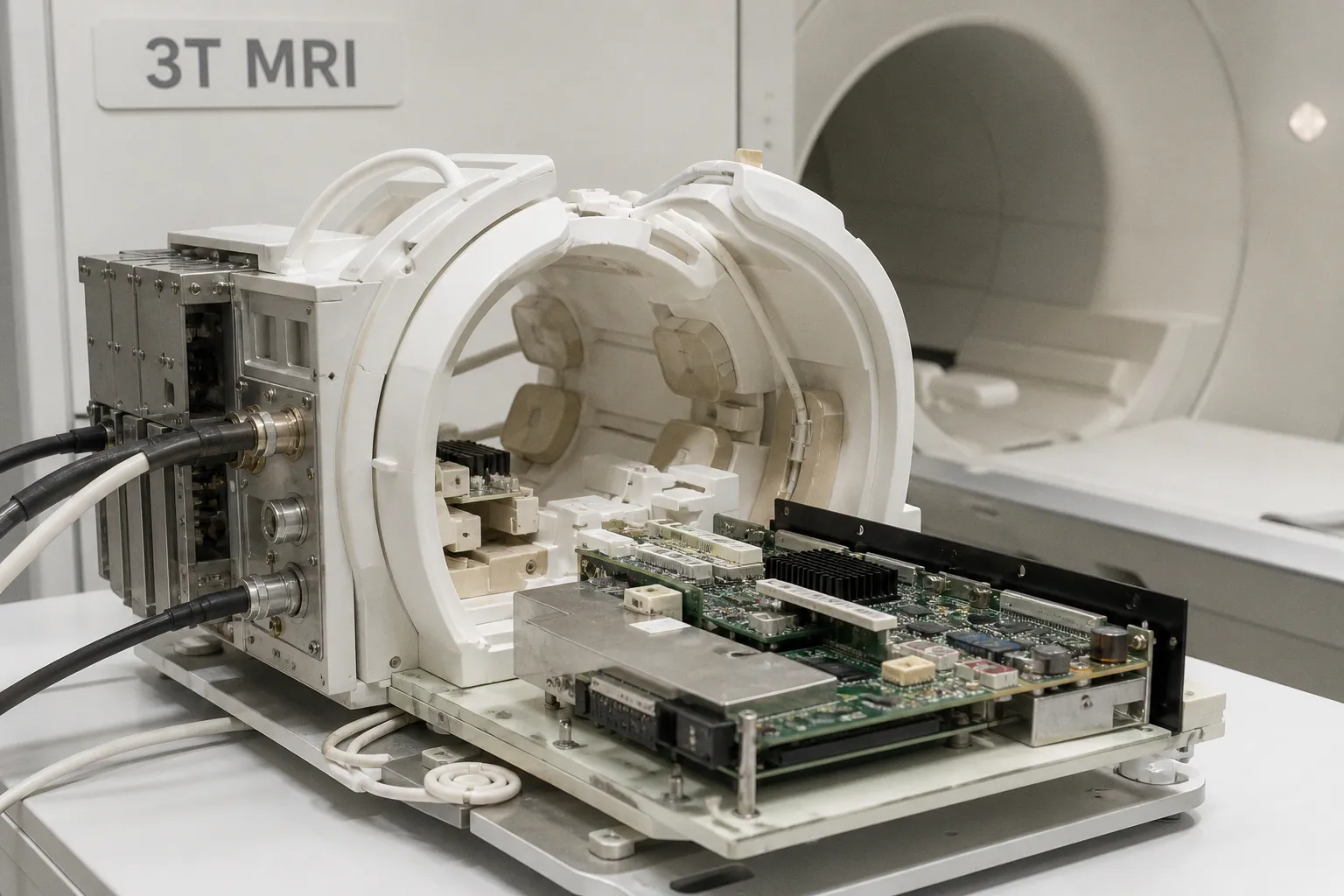
A real-time volumetric seizure imager — and a disclosure vacuum
That is the full extent of the available factual record. No field strength, no temporal resolution, no reconstruction algorithm, no clinical cohort, no vendor or institution identified in the current material. The publication date sits in mid-August 2026; the underlying study, preprint, or specification sheet is not named in what is available.
For an audience that treats MRI as a signal-processing engine, the headline alone encodes the constraint surface. A seizure is the worst-case acquisition scenario: gross head motion, rapid cortical propagation, unpredictable onset and offset. Volumetric capture under those conditions degrades k-space consistency by orders of magnitude relative to a compliant subject. The "real-time" qualifier then imposes a latency budget that constrains the reconstruction architecture — iterative deep-learning methods with slow convergence are excluded from any window tight enough to inform acute decisions. The headline is a performance claim; the physics between claim and measurement is not on the table.
What the technical disclosure must contain
The signal to watch is the underlying methodology. Specifically: the field strength (1.5T, 3T, or 7T — each yields materially different SNR and therefore different achievable frame rates for volumetric updates), the readout trajectory and its motion tolerance, and the motion-correction strategy (navigator echoes, optical tracking, or learned). Without those numbers, "real-time" remains operationally undefined. With them, the claim can be audited against gradient slew rate limits and reconstruction stability bounds. Until that disclosure lands, the system is a black box advertising a specification it has not justified.
The Cairns Post separately flagged ASX-listed companies advancing medical imaging and pathology capabilities, though the available material yields no further technical detail to evaluate.
Adjacent: detector-side consolidation in the imaging hardware stack
Separate event, relevant to the supply ecosystem: Teledyne Technologies entered a definitive merger agreement to acquire Varex Imaging for $18.90 per share in an all-cash transaction, with an aggregate value of approximately $1.1 billion including net debt and equity awards. The deal is expected to close in early 2027 subject to regulatory clearances and Varex stockholder approval. The acquisition brings photon-counting detectors and specialised high-radiation oncology detectors into Teledyne's digital imaging portfolio — X-ray tube and detector technology rather than MRI hardware, but a signal of continued vertical integration across the imaging OEM supply chain. Downstream effects on detector pricing and availability for hybrid architectures are plausible; nothing MRI-specific is confirmed in available material.