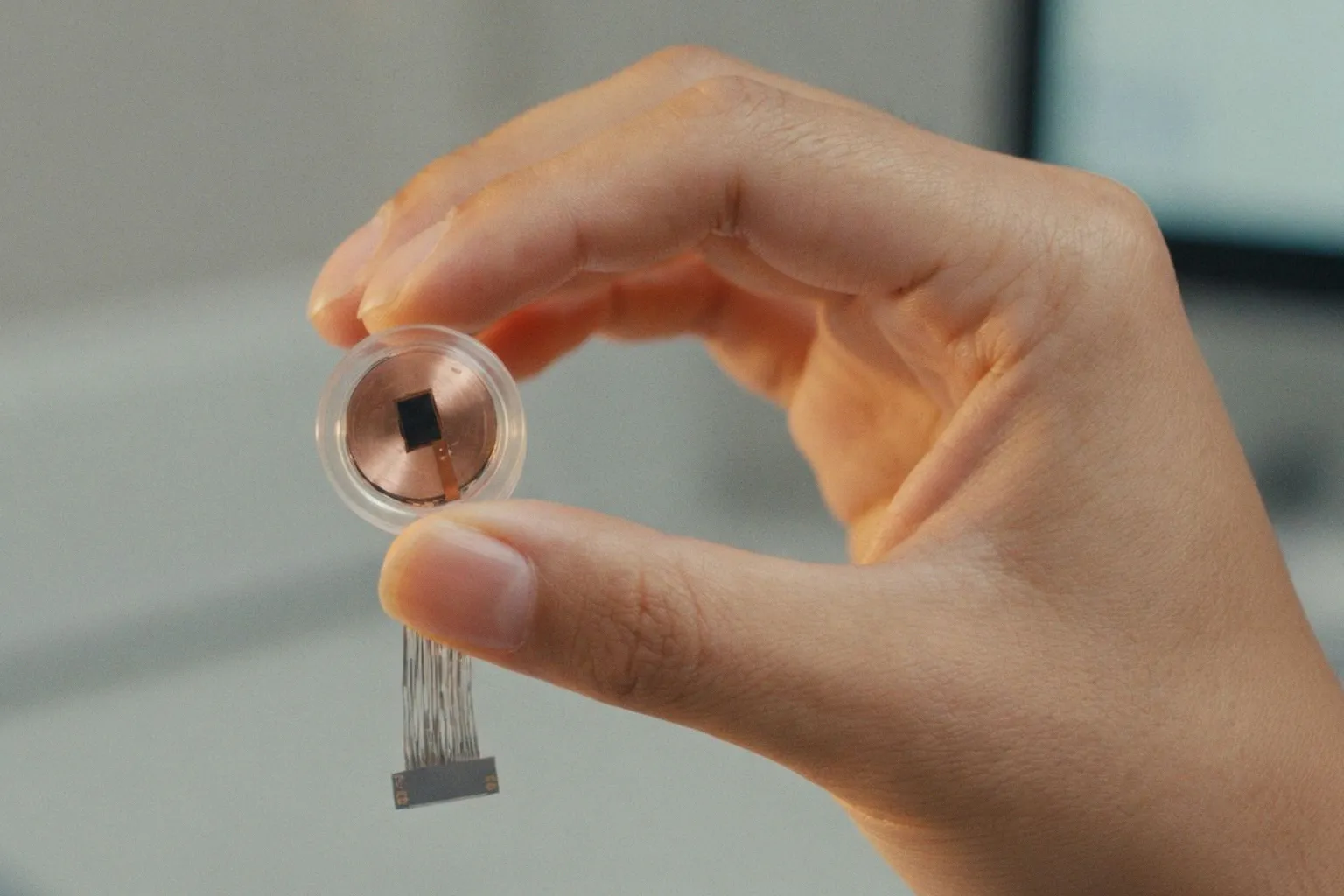
According to a recent account in TechCrunch, Tether Evo's BrainWhisperer project is reporting variable accuracy around 98.3% in translating brain signals into text from research subjects using implanted brain-computer interfaces — a figure that, if it holds across broader clinical populations, begins to redraw what we consider possible for patients who have lost the ability to speak.
From phonemes to sentences, one decoded thought at a time
The core architecture is worth tracing carefully, because it reveals where the engineering choices meet the biology. BrainWhisperer sits atop OpenAI's Whisper automatic speech recognition model and extends it with a tokenizing layer that ingests neural signals rather than audio. A Low-Rank Adaptation (LoRA) fine-tuning step then progressively lowers the word error rate across separate trial sessions — the kind of incremental refinement that matters enormously when every percentage point translates into more intelligible daily conversation for a patient.
This is not purely a model story. The system draws on three commonly used brain-to-text decoding datasets — Willet, Card, and Kunz — and uses an ensemble of five models for each, trained with an Adam Optimizer over a 100-epoch cosine learning rate schedule. A Weighted Finite-State Transducer converts the phoneme sequences each model generates into candidate transcriptions. The decoded output that circulated in the report read, in essence, "Do you know where it might have gone? I am an artist, lost in my own vision. I don't think so anymore." The fact that an intracranial implant can recover that kind of sentence structure from cortical activity hints at the granular linguistic information preserved in the motor and speech-related regions, even in severely impaired individuals.
In the recent Brain-to-Text '25 Kaggle Competition, the entry ranked fourth against 466 participants with a 1.78% word error rate — only 0.25 percentage points behind first place. For clinician-researchers watching this space, that proximity matters: the gap between leaderboard position and clinical deployability is narrowing, even as questions of generalization across speakers, electrode longevity, and surgical candidacy remain open.
Where the standard-setters are heading
Consider the implications for the broader ecosystem in which this work lands. As reported by Retail News Asia, China's Ministry of Industry and Information Technology has issued draft guidelines calling for more than 40 brain-computer interface standards by 2028, expanding to over 80 by 2030, with the aim of pushing at least 100 domestic companies toward uniform technical rules — and of leading or joining the creation of more than 10 international standards. The directive slots neural interface technology into the country's 15th five-year plan as a priority industry of the future. Alongside regulatory clearances for implants such as Neuracle's hand-movement restoration device, and non-invasive hardware from players like BrainCo, the standards push suggests that the next few years will not just be about who decodes fastest, but about who defines the reference architectures.
What to watch without rushing
This shift allows us to recalibrate our expectations for what an implantable speech prosthesis might reasonably deliver inside a research protocol — without yet conflating benchmark accuracy with everyday reliability. The paid-content nature of the original announcement, flagged by TechCrunch itself, is a reminder to read the figures as a vendor-reported milestone rather than an independently verified clinical outcome. For the radiologists, neuroscientists, and medical software developers in our audience, the practical watchpoints are clear: replication of that 1.78% word error rate across diverse patient anatomies, the stability of LoRA-fine-tuned decoders over months rather than sessions, and how emerging international standards begin to constrain — or enable — the pipelines we are quietly building on top of Whisper-class models today. The biology has always been willing; the calibration curve, as ever, will take time.