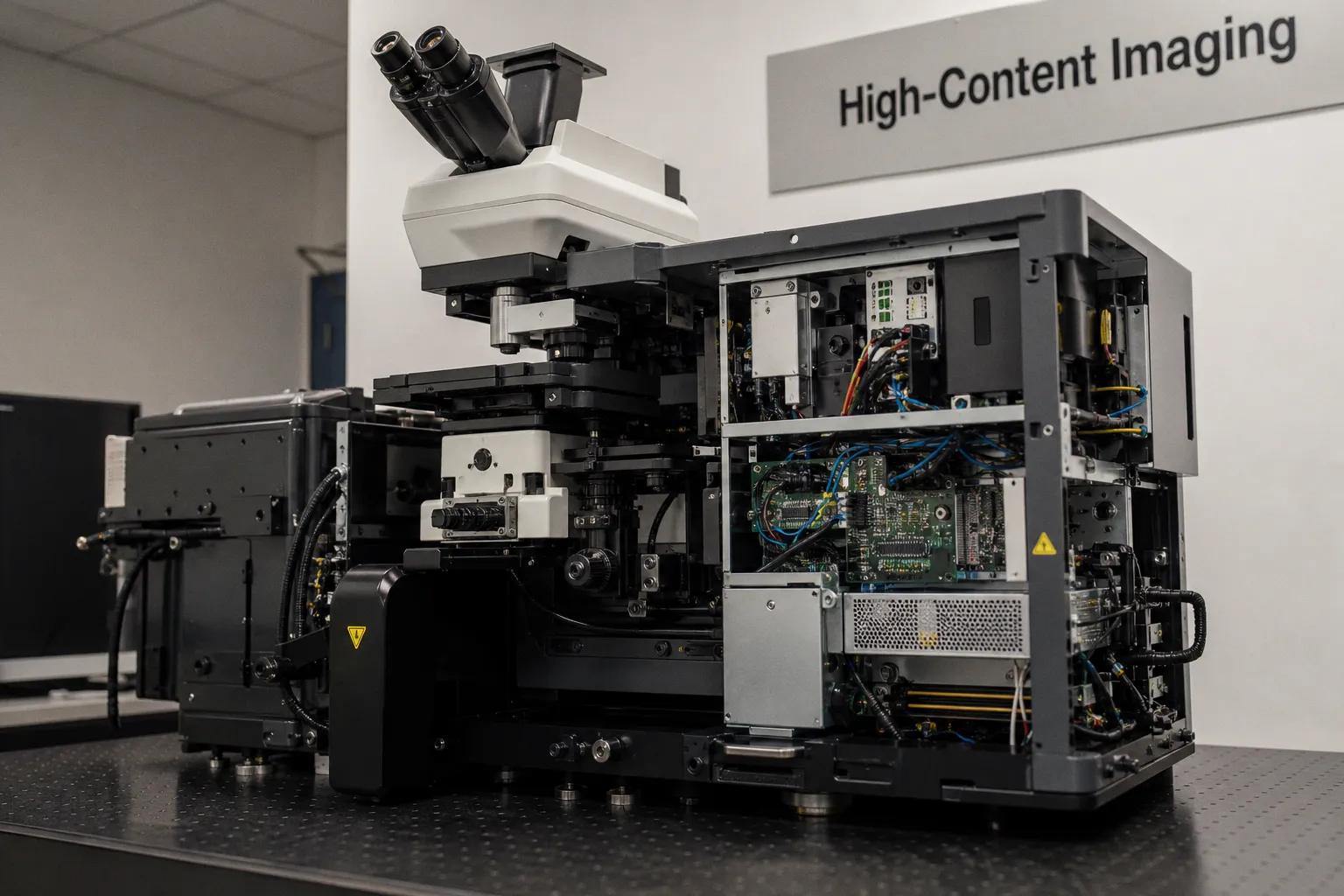
The coverage lands inside a single week's cluster of commercial signals: a MarketsandMarkets projection sizing the medical image analysis software market at $6.42 billion by 2031 (carried by Yahoo Finance), a parallel outlook from the same analyst house on US AI in medical diagnostics through 2029, and an openPR.com brief on medical imaging information systems extending to 2033, with MRI flagged as a segment.
The throughput constraint that defines the claim
High-content imaging is, by construction, a throughput-limited pipeline. Multi-well plate acquisition stacks against multi-channel fluorescence; per-cell feature extraction then pushes the data rate past what a single workstation can ingest without parallelization. When AI image analysis enters the stack, the binding constraint moves laterally: acquisition yields to inference latency, and manual annotation yields to ground-truth density. Any claim of acceleration must be measured against these two ceilings — measured on a held-out plate, not the developer's reference run. Plate count alone is a marketing number, not a benchmark.
Where the market signal lands — and where it doesn't
The $6.42 billion by 2031 figure, attributed to MarketsandMarkets, is not a forecast of high-content imaging adoption. It is the projected spend envelope for the broader medical image analysis software category, weighted toward clinical radiology. For readers operating preclinical pipelines, the figure translates into a procurement question: which vendor stacks currently tolerate the per-plate data volumes that AI-assisted phenotypic profiling produces, and which silently degrade under them — and what happens to inference latency when the GPU is shared with a reconstruction job. The MarketsandMarkets AI-in-diagnostics outlook through 2029 frames the same question from the demand side, while the openPR.com brief on imaging information systems to 2033 — with MRI as a flagged segment — points at where storage and information-system pressure will compound over the same horizon.
What to verify before citing
The News-Medical entry carries an indexed title but no accessible methodology at the time of this write-up. Before the workflow is treated as a reference standard, three specifics should be confirmed: the imaging modality stack (confocal, widefield, or otherwise); the AI architecture (classical computer vision versus deep learning, supervised versus self-supervised); and the size and provenance of the validation cohort. A throughput claim without those three reads as a benchmark, not evidence — and at the volumes phenotypic profiling produces, an unvalidated pipeline degrades the entire downstream analysis, not just the first plate. The cost of a misread phenotype compounds across every downstream assay that consumes the labeled dataset.