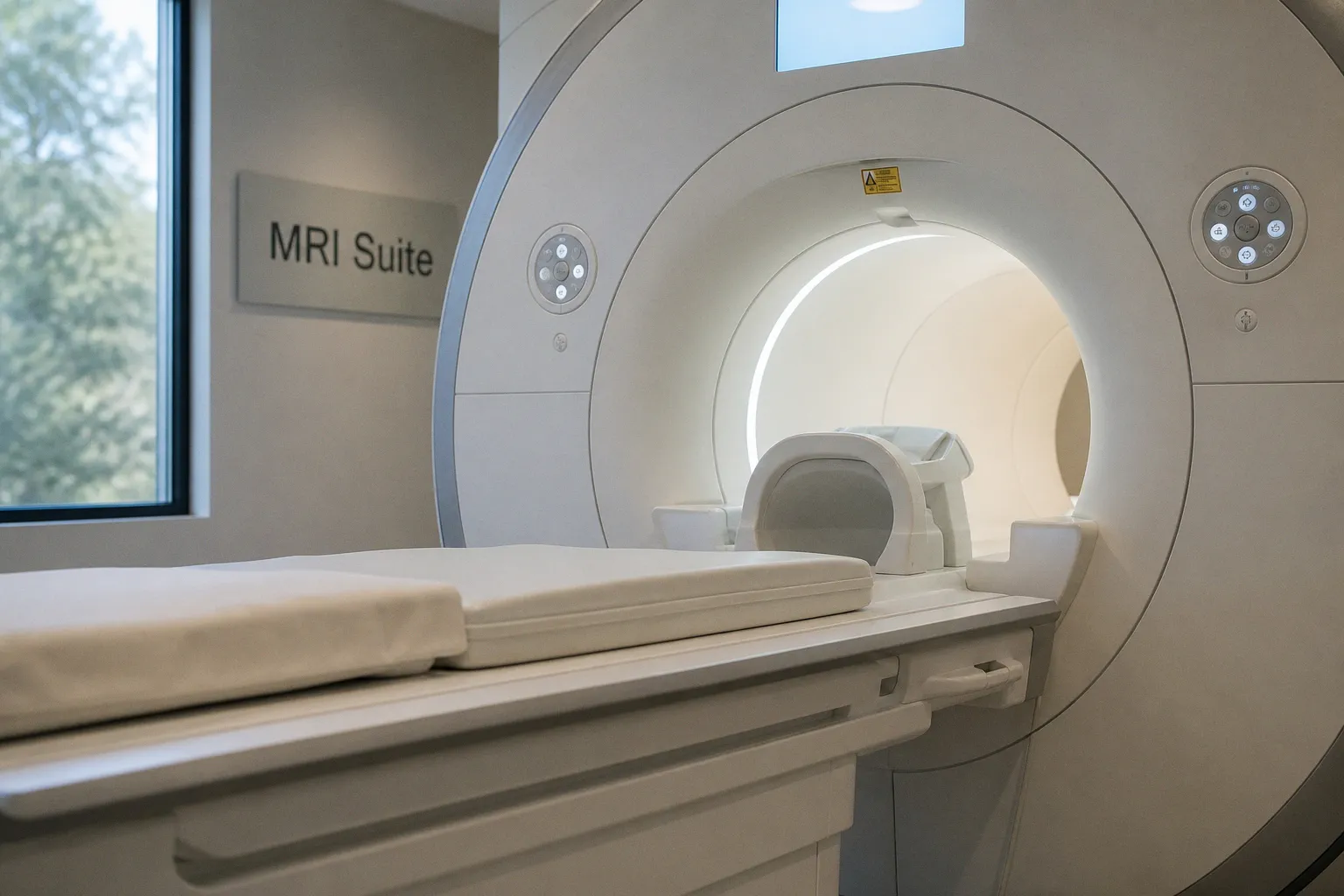
According to Medical Xpress, structural MRI may now carry prognostic weight in early-onset Alzheimer's disease — a reclassification that elevates the scanner from diagnostic confirmation to forward-looking signal extraction. The claim currently rests on headline reporting; the underlying acquisition parameters, cohort size, and quantitative biomarker remain unpublished.
The signal constraints
Early-onset Alzheimer's presents a particular acquisition problem. Atrophy diverges from the late-onset signature, favoring posterior cortical and frontotemporal thinning rather than the canonical hippocampal volume loss that conventional pipelines are tuned for. Extracting predictive weight from structural MRI demands high-resolution T1-weighted sequences with sub-millimetric consistency, controlled motion, and parcellation pipelines invariant across sites. Each constraint tolerates specific tolerances: gradient slew rates bound spatial resolution; B0 inhomogeneity degrades segmentation accuracy; small cohorts erase statistical power.
The scanner behaves as a mathematical engine. Its output constrains the question. If the acquisition cannot resolve cortical thickness deltas that separate fast from slow progressors, no downstream reconstruction recovers them.
Adjacent MRI signal in the same cluster
The rest of this week's reporting tightens MRI's clinical load elsewhere in neurodegenerative and neuro-oncologic care. According to AuntMinnie, real-world brain MRI detected amyloid-related imaging abnormalities in 21% of donanemab patients — a surveillance volume that pushes the modality toward routine serial imaging in anti-amyloid therapy.
Separately, a Delphi consensus endorsed by ESTRO, ESNR, and EORTC establishes standardized terminology for treatment-related imaging abnormalities on post-radiotherapy brain MRI, per Neuro-Oncology. Both threads sharpen the same underlying demand: MRI's reliability as either prognostic instrument or safety watchdog depends on reproducible sequence design across scanners and vendors.
What still blocks the headline
Until acquisition parameters, segmentation methodology, and effect size surface from the Medical Xpress report, the prediction claim is directional — a proof of concept held hostage to the signal-to-noise ratio of the underlying scans. For radiologists, neuroscientists, and pipeline engineers working around early-onset Alzheimer's, the disciplined move is to audit sequence standardization against candidate biomarkers rather than refactor pipelines to a headline-level claim.