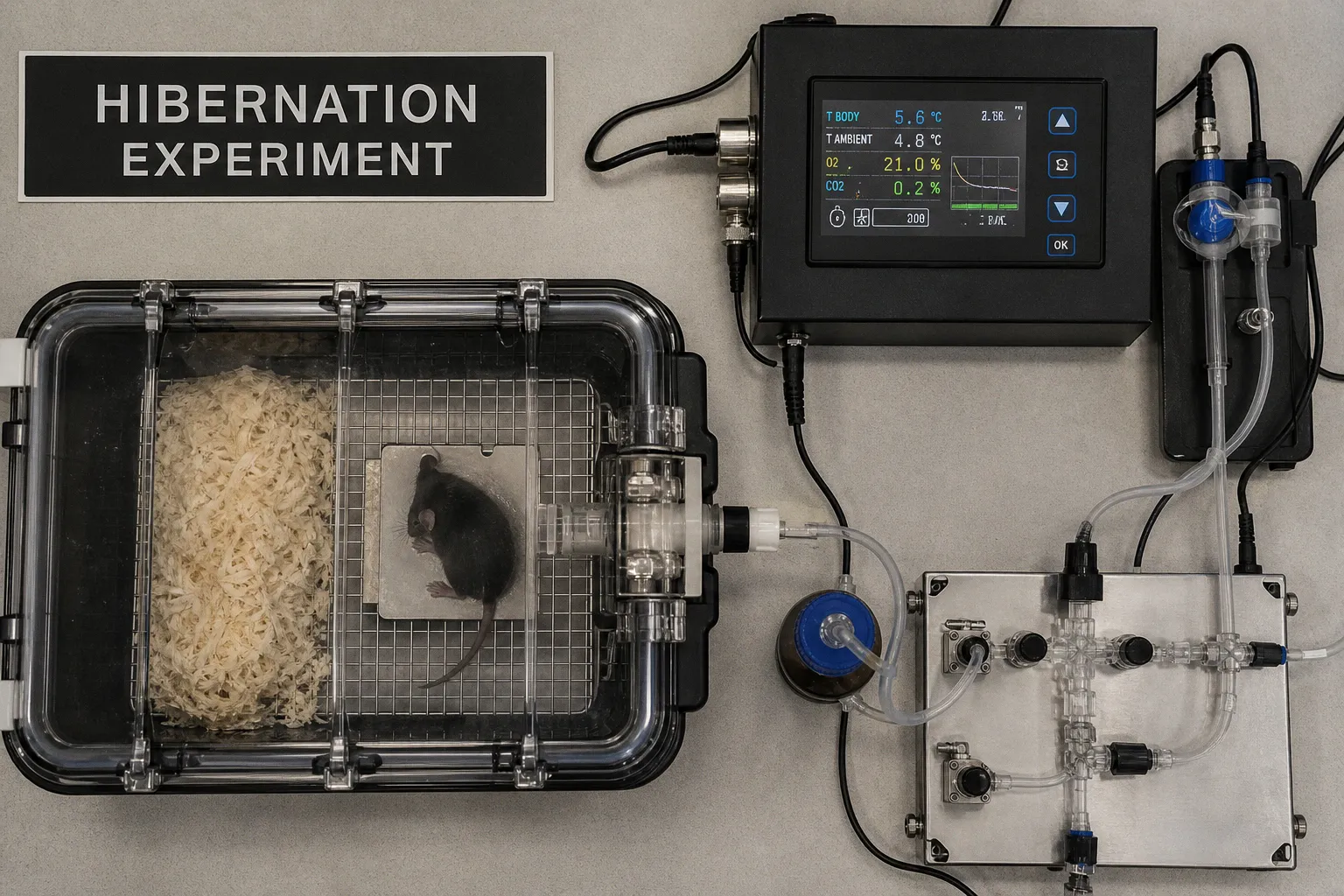
Artificial Hibernation Shifts the Memory Problem from Synaptic Strength to Network Architecture
According to BioTechniques, researchers from the Okinawa Institute of Science and Technology and collaborating Japanese institutions have used artificial hibernation in mice to test a long-standing assumption about memory retention. The study, published in Science, indicates that long-term recall may depend less on the persistence of every strong synaptic connection than on the higher-order architecture of the memory network. For neuroimaging and computational neuroscience, the distinction is material: a stable memory trace may be a pattern-level property, not a durable set of individually dominant edges.
The physical trace is not as static as assumed
The conventional model is straightforward. Repeated activity strengthens synapses through long-term potentiation. Neurons release more neurotransmitter. Receiving cells increase sensitivity. Dendritic spines become larger, expanding the physical contact between cells. Stronger, more stable synapses have therefore been treated as the structural substrate of long-term memory.
The new work does not discard long-term potentiation as a mechanism for forming memories. It constrains its role in maintaining them. Recent studies have already shown that the cellular composition and connectivity of an engram can change over time without eliminating recall. The artificial-hibernation experiment was designed to stress that system further.
During hibernation, metabolism falls, brain activity slows sharply, and connections between brain cells can be reduced. The brain also shrinks during the process. Yet hibernating animals can retain memories formed before entering that state, including recognition of other animals and locations associated with food, according to the background described by Live Science.
That creates a direct engineering problem for any memory model based only on durable, high-strength synapses. If individual links are removed or degraded while the memory remains accessible, the relevant invariant must exist at another level.
Topology becomes the critical variable
The reported answer is engram architecture: the clustered pattern of connections linking cells within the memory-bearing network. BioTechniques describes small clusters of engram-to-engram synapses as being preserved sufficiently to support accurate recall after hibernation.
This is not a claim that every synapse is interchangeable. It is a claim about weighting. A network can tolerate local loss if the arrangement of surviving connections preserves the computational structure required for retrieval. In mathematical terms, the memory signal may be encoded in the topology and organization of the subnetwork rather than in the absolute strength of each connection.
That distinction matters for neuroimaging. MRI-based analyses generally measure indirect, aggregated observables. Functional signals reflect population activity. Structural measurements capture tissue-scale properties. Neither automatically resolves the fine-grained synaptic architecture described in this study. A stable macroscopic pattern should therefore not be treated as proof that the same microscopic connections remain intact.
The result also places a constraint on machine-learning interpretations of brain data. A decoder that predicts memory from a distributed pattern may be detecting a network configuration that tolerates cellular turnover, rather than identifying a fixed biological address. Performance can remain stable while the underlying representation drifts.
What the study does—and does not—establish
The evidence concerns mice subjected to artificial hibernation. It does not establish that human long-term memory behaves identically, nor does it provide a clinical imaging protocol or a validated biomarker. The available reporting also does not specify MRI acquisition parameters, k-space trajectories, signal-to-noise ratios, reconstruction methods, or a direct translation into patient-level neuroimaging.
The practical conclusion is narrower and more useful. When evaluating claims about persistent memory representations, researchers should separate three layers: synaptic strength, cellular membership, and network architecture. Stability at one layer does not guarantee stability at the others.
For software developers, that means testing whether an apparent memory signature survives controlled perturbation and representational drift. For imaging researchers, it means resisting the easy equivalence between a repeatable voxel-level pattern and a preserved microscopic engram. The study’s central constraint is blunt: long-term memory may survive because the architecture is robust, not because every component remains strong.
More products