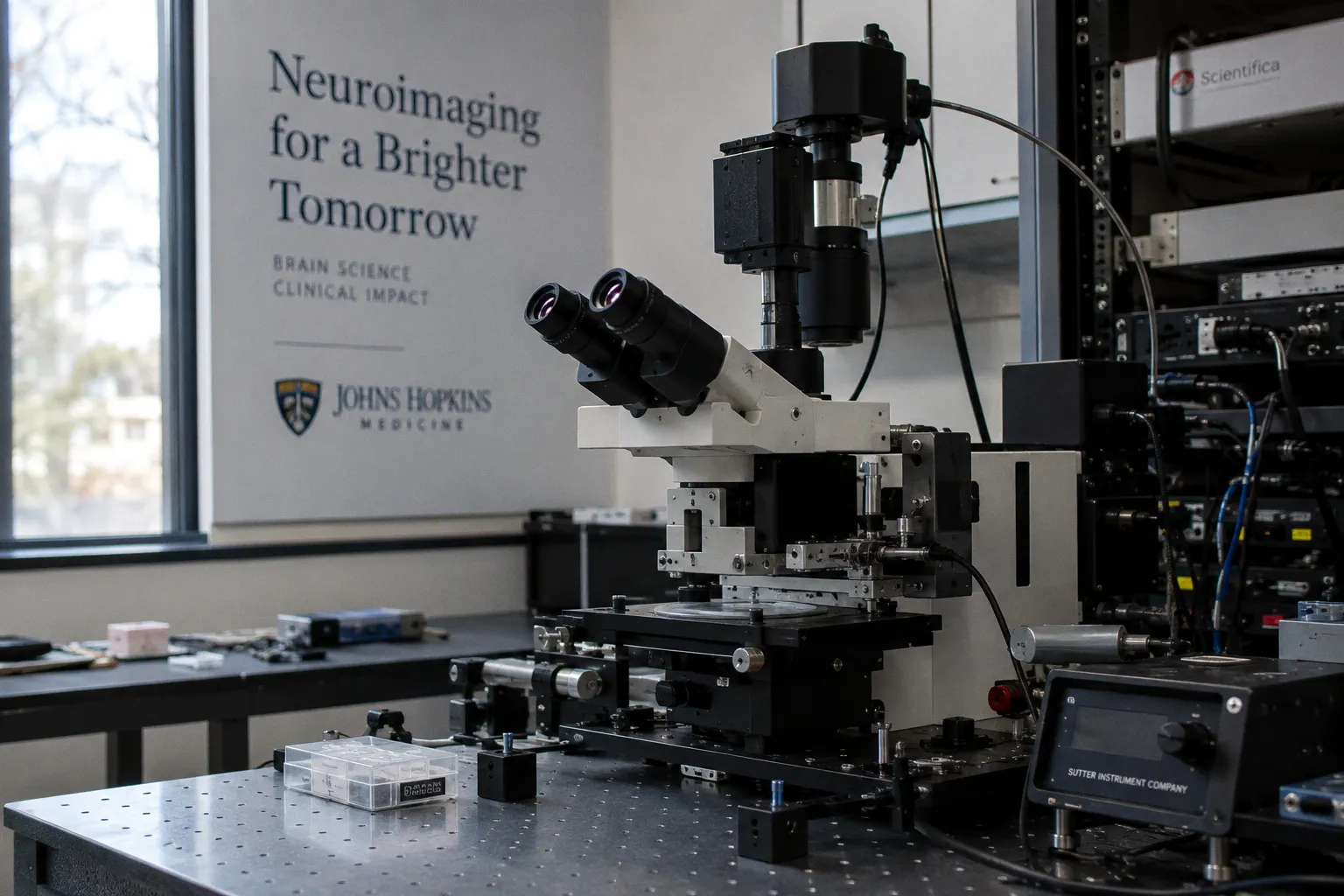
A 72-hour continuous in vivo imaging window. That is the operational envelope Johns Hopkins researchers claim with CloudScope, a cloud-connected neuroimaging platform that decouples acquisition duration from the local storage and processing ceiling that has historically truncated longitudinal brain studies.
The system streams extended acquisitions to remote infrastructure, then pairs those long-duration datasets with AI trained to predict animal mobility states from neuronal activity measurements alone — collapsing the two-stage imaging-plus-behavior protocol into a single acquisition stream.
The acquisition ceiling
Conventional in vivo brain imaging operates under a tight constraint: continuous sessions strain gradient duty cycles, thermal budgets, and on-premise storage. CloudScope does not redesign the scanner. It relocates the bottleneck. Data moves off-site; reconstruction moves to cloud compute; the host scanner continues to obey its physics without the archival drag. The demonstrated result, per the Johns Hopkins report, is tracking brain cancer cell trajectories across 72 hours without the data loss that would normally terminate a session.
This is an architectural shift, not a hardware breakthrough. The signal-to-noise ratio remains bound by field strength and coil geometry. What changes is the time axis the experiment can occupy.
The AI pairing
What distinguishes the pipeline is the model consuming those datasets. Trained on extended neuronal recordings, it infers mobility states from neural activity alone. The protocol implication is direct: a behavioral camera is no longer a hard requirement for inferring subject state during long acquisitions.
The constraint is calibration. A model trained on healthy trajectories will yield biased estimates against tumor-bearing or lesioned subjects. The error bound across pathological populations is not yet documented.
Adjacent signal
Two parallel efforts converge on the same frontier. Nature published SORDINO — a silent, sensitive, and artifact-resistant fMRI framework for awake, behaving mice, attacking the acoustic noise floor that corrupts long scans. A separate group from the Shenzhen Institute reported an LD-2P-FLIM two-photon system in PNAS, sustaining 15.73 megapixels per second across dual regions for quantitative calcium imaging — a data throughput that redefines the space-bandwidth product ceiling for functional optical recording.
Three technologies. Three bottlenecks. Duration. Acoustic artifact. Optical throughput. The integration layer between them remains unclaimed.
What to watch
Three failure modes will decide clinical utility. First, k-space trajectory consistency across multi-day sessions degrades as subject physiology shifts. Second, cloud round-trip latency must remain below acquisition cadence or the platform reverts to batch. Third, AI inference accuracy against ground-truth behavioral labels in diseased cohorts needs publication.
CloudScope extends the imaging horizon. Whether it extends the diagnostic horizon depends on numbers the current release does not yet provide.